
A Stability Technique for Evolution Partial Differential Equations: A Dynamical Systems Approach - Juan Luis Vázquez,Victor A. Galaktionov

-20% with code BOOKS
Shipping in 17-23 days
30-day return policy
common feature is that these evolution problems can be formulated as asymptoti cally small perturbations of certain dynamical systems with better-known behaviour. Now, it usually happens that the perturbation is small in a very weak sense, hence the difficulty (or impossibility) of applying more classical techniques. Though the method originated with the analysis of critical behaviour for evolu tion PDEs, ... Full description
You May Also Like
 TOP
TOP

Determined: The Science of Life Without Free Will
-20% with code BOOKS
In stock at our supplier
TOP

The Light Eaters: How the Unseen World of Plant Intelligence Offers a New Understanding of Life on Earth
-20% with code BOOKS
In stock at our supplier
 TOP
TOP

Why We Sleep: Unlocking the Power of Sleep and Dreams
-20% with code BOOKS
In stock
TOP

The Rise and Fall of the Dinosaurs: A New History of a Lost World
-20% with code BOOKS
In stock at our supplier
TOP

Factfulness: Ten Reasons We're Wrong About the World--and Why Things Are Better Than You Think
Ola Rosling, Anna Rosling Rönnlund, Hans Rosling
-20% with code BOOKS
In stock at our supplier
TOP

Biology: A Global Approach, Global Edition
Neil Campbell, Rebecca Orr, Lisa Urry, Peter Minorsky, Michael Cain, Jane Reece, Steven Wasserman
-20% with code BOOKS
In stock at our supplier
TOP

Six Not-so-easy Pieces: Einstein's Relativity, Symmetry, and Space-Time
Richard P. Feynman, Robert B. Leighton, Matthew Sands
-20% with code BOOKS
In stock at our supplier
TOP

Entangled Life: How Fungi Make Our Worlds, Change Our Minds and Shape Our Futures
-20% with code BOOKS
In stock at our supplier
TOP


The Age of Alchemy: How Early Innovators Shaped Modern Chemistry
-20% with code BOOKS
In stock at our supplier
TOP

The Secrets of our DNA: How Genetics has Changed the World
-20% with code BOOKS
In stock at our supplier
TOP

Janeway's Immunobiology
Leslie J. Berg, Kenneth Murphy, Casey Weaver
-20% with code BOOKS
In stock at our supplier
TOP

Behave: The Biology of Humans at Our Best and Worst
-20% with code BOOKS
In stock at our supplier
TOP
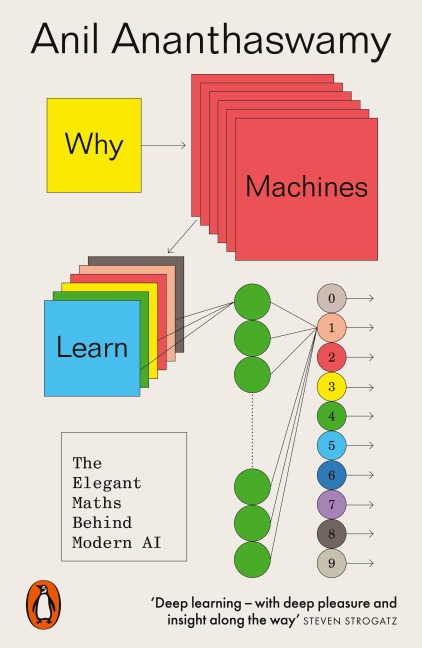
Why Machines Learn: The Elegant Maths Behind Modern AI
-20% with code BOOKS
In stock at our supplier
TOP

The Feynman Lectures on Physics. The New Millennium Edition
Matthew Sands, Robert Leighton, Richard Feynman
-20% with code BOOKS
In stock at our supplier
 TOP
TOP

Life As No One Knows It: The Physics of Life's Emergence
-20% with code BOOKS
In stock at our supplier
TOP

The Rise and Reign of the Mammals: A New History, from the Shadow of the Dinosaurs to Us
-20% with code BOOKS
In stock at our supplier
TOP

The Brain That Changes Itself: Stories of Personal Triumph from the Frontiers of Brain Science
-20% with code BOOKS
In stock at our supplier
TOP

How to Solve it: A New Aspect of Mathematical Method
-20% with code BOOKS
In stock at our supplier
Description
common feature is that these evolution problems can be formulated as asymptoti cally small perturbations of certain dynamical systems with better-known behaviour. Now, it usually happens that the perturbation is small in a very weak sense, hence the difficulty (or impossibility) of applying more classical techniques. Though the method originated with the analysis of critical behaviour for evolu tion PDEs, in its abstract formulation it deals with a nonautonomous abstract differ ential equation (NDE) (1) Ut = A(u) + C(u, t), t > 0, where u has values in a Banach space, like an LP space, A is an autonomous (time-independent) operator and C is an asymptotically small perturbation, so that C(u(t), t) ~ ° as t ~ 00 along orbits {u(t)} of the evolution in a sense to be made precise, which in practice can be quite weak. We work in a situation in which the autonomous (limit) differential equation (ADE) Ut = A(u) (2) has a well-known asymptotic behaviour, and we want to prove that for large times the orbits of the original evolution problem converge to a certain class of limits of the autonomous equation. More precisely, we want to prove that the orbits of (NDE) are attracted by a certain limit set [2* of (ADE), which may consist of equilibria of the autonomous equation, or it can be a more complicated object.
More Information
| Author | Juan Luis Vázquez, Victor A. Galaktionov |
|---|---|
| Publisher | Birkhäuser Boston |
| Series | Progress in Nonlinear Differential Equations and Their Applications |
| Release year | 2003 |
| Cover type | Hardcover |
| EAN | 9780817641467 |