
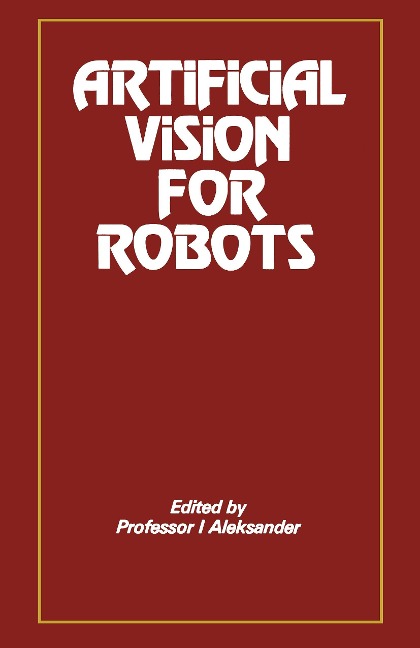
Artificial Vision for Robots - I. Aleksander
-30% with code BOOKS
Shipping in 12-18 days
30-day return policy
I. ALEKSANDER Department of Electrical Engineering and Electronics BruneI University, England The three key words that appear in the title of this book need some clarification. First, how far does the word robot reach in the context of indus trial automation? There is an argument maintaining that this range is not fixed, but increases with advancing technology. The most limited definition of the robot is a ... Full description
You May Also Like
 TOP
TOP

The Demon-Haunted World: Science as a Candle in the Dark
-30% with code BOOKS
In stock at our supplier
TOP

The Art of Uncertainty: How to Navigate Chance, Ignorance, Risk and Luck
-30% with code BOOKS
Out of stock
TOP

Heart Rate Variability: Science and Strategies for Peak Performance
Marco Altini, Sylvain Laborde, Dan Plews, Emma Mosley
-30% with code BOOKS
Out of stock
TOP

Many Faces, One Purpose: A Manager's Handbook on Women in Firefighting
U. S. Fire Administration, Homeland Security
-30% with code BOOKS
Out of stock
TOP

Thinking in Systems: International Bestseller
-30% with code BOOKS
In stock at our supplier
TOP

The Gulf Moment: Arab Relations Since 2011
Florence Gaub, U. S. Army War College, Strategic Studies Institute
-30% with code BOOKS
Out of stock
 TOP
TOP

Introduction to Algorithms
Ronald L. Rivest, Charles E. Leiserson, Clifford Stein, Thomas H. Cormen
-30% with code BOOKS
In stock at our supplier
TOP

Skin in the Game: Hidden Asymmetries in Daily Life
-30% with code BOOKS
In stock at our supplier
TOP

101 Things I Learned in Architecture School
-30% with code BOOKS
In stock at our supplier
TOP

Dinosaurs and Prehistoric Life: The Definitive Visual Guide to Prehistoric Animals
-30% with code BOOKS
In stock at our supplier
TOP

Worth Dying For: The Power and Politics of Flags
-30% with code BOOKS
In stock at our supplier
TOP


Crossing Borders: About the birth of the Consortium of European Research Libraries, the organisation's early years and its path to maturity, spanning the period from the late twentieth century to the first decades of the twenty-first century
-30% with code BOOKS
In stock at our supplier
TOP

The Code Book: The Science of Secrecy from Ancient Egypt to Quantum Cryptography
-30% with code BOOKS
In stock at our supplier
 TOP
TOP

Only Dull People Are Brilliant at Breakfast
-30% with code BOOKS
In stock at our supplier
TOP

Playing It by the Book: Printed and Manuscript Book Games in Early Modern Europe
-30% with code BOOKS
In stock at our supplier
TOP

International Economics: Theory and Policy, Global Edition
Paul Krugman, Maurice Obstfeld, Marc Melitz
-30% with code BOOKS
In stock at our supplier
TOP

The Dictionary of Obscure Sorrows
-30% with code BOOKS
In stock at our supplier
TOP
The Unaccountability Machine: Why Big Systems Make Terrible Decisions
-30% with code BOOKS
In stock at our supplier
Description
I. ALEKSANDER Department of Electrical Engineering and Electronics BruneI University, England The three key words that appear in the title of this book need some clarification. First, how far does the word robot reach in the context of indus trial automation? There is an argument maintaining that this range is not fixed, but increases with advancing technology. The most limited definition of the robot is also the earliest. The history is worth following because it provides a convincing backdrop to the central point of this book: vision is likely to epitomize the technolo gical advance, having the greatest effect in enlarging the definition and range of activity of robots. In the mid 1950s it was foreseen that a purely mechanical arm-like device could be used to move objects between two fixed locations. This was seen to be cost-effective only if the task was to remain fixed for some time. The need to change tasks and therefore the level of programmability of the robot was a key issue in the broadening of robot activities. Robots installed in industry in the early 1960s derived their programmability from a device called apinboard. Ver tical wires were energized sequentially in time, while horizontal wires, when energized, would trigger off elementary actions in the manipulator arm. The task of reprogramming was a huge one, as pins had to be reinserted in the board, connecting steps in time with robot actions.
More Information
| Author | I. Aleksander |
|---|---|
| Publisher | Springer New York |
| Release year | 2012 |
| Cover type | Softcover |
| EAN | 9781468468571 |