
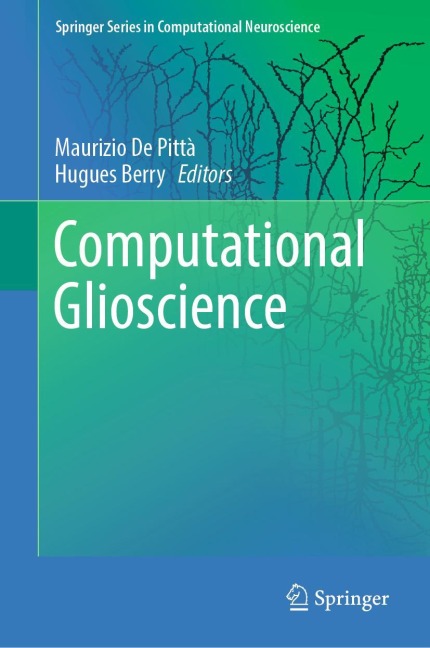
Computational Glioscience -
-20% with code BOOKS
Shipping in 17-23 days
30-day return policy
Over the last two decades, the recognition that astrocytes - the predominant type of cortical glial cells - could sense neighboring neuronal activity and release neuroactive agents, has been instrumental in the uncovering of many roles that these cells could play in brain processing and the storage of information. These findings initiated a conceptual revolution that leads to rethinking how brain communicat ... Full description
You May Also Like
 TOP
TOP

Six Not-so-easy Pieces: Einstein's Relativity, Symmetry, and Space-Time
Richard P. Feynman, Robert B. Leighton, Matthew Sands
-20% with code BOOKS
In stock at our supplier
TOP

Six Easy Pieces: Essentials of Physics Explained by Its Most Brilliant Teacher
Richard P. Feynman, Robert B. Leighton, Matthew Sands
-20% with code BOOKS
In stock at our supplier
TOP
Behave: The Biology of Humans at Our Best and Worst
-20% with code BOOKS
In stock at our supplier
TOP

Determined: The Science of Life Without Free Will
-20% with code BOOKS
In stock at our supplier
TOP


The Age of Alchemy: How Early Innovators Shaped Modern Chemistry
-20% with code BOOKS
In stock at our supplier
TOP
The Secrets of our DNA: How Genetics has Changed the World
-20% with code BOOKS
In stock at our supplier
TOP

Why We Sleep: Unlocking the Power of Sleep and Dreams
-20% with code BOOKS
In stock
TOP

Biology: A Global Approach, Global Edition
Neil Campbell, Rebecca Orr, Lisa Urry, Peter Minorsky, Michael Cain, Jane Reece, Steven Wasserman
-20% with code BOOKS
In stock at our supplier
TOP
Why Machines Learn: The Elegant Maths Behind Modern AI
-20% with code BOOKS
In stock at our supplier
TOP

A Short History of Nearly Everything 2.0
-20% with code BOOKS
In stock at our supplier
TOP

Astrophysics for People in a Hurry: Essays on the Universe and Our Place Within It
-20% with code BOOKS
In stock at our supplier
TOP

The Rise and Fall of the Dinosaurs: A New History of a Lost World
-20% with code BOOKS
In stock at our supplier
TOP

The Rise and Reign of the Mammals: A New History, from the Shadow of the Dinosaurs to Us
-20% with code BOOKS
In stock at our supplier
TOP

Learn Faster, Perform Better: A Musician's Guide to the Neuroscience of Practicing
-20% with code BOOKS
In stock at our supplier
TOP

Beyond Inheritance: Our Ever-Mutating Cells and a New Understanding of Health
-20% with code BOOKS
In stock at our supplier
TOP

A Brief History of Time: From the Big Bang to Black Holes
-20% with code BOOKS
In stock at our supplier
 TOP
TOP

Thing Explainer: Complicated Stuff in Simple Words
-20% with code BOOKS
In stock at our supplier
TOP
Introduction to Quantum Mechanics
Darrell F. Schroeter, David J. Griffiths
-20% with code BOOKS
In stock at our supplier
TOP

Universe: The Definitive Visual Guide
-20% with code BOOKS
In stock at our supplier
Description
Over the last two decades, the recognition that astrocytes - the predominant type of cortical glial cells - could sense neighboring neuronal activity and release neuroactive agents, has been instrumental in the uncovering of many roles that these cells could play in brain processing and the storage of information. These findings initiated a conceptual revolution that leads to rethinking how brain communication works since they imply that information travels and is processed not just in the neuronal circuitry but in an expanded neuron-glial network. On the other hand the physiological need for astrocyte signaling in brain information processing and the modes of action of these cells in computational tasks remain largely undefined. This is due, to a large extent, both to the lack of conclusive experimental evidence, and to a substantial lack of a theoretical framework to address modeling and characterization of the many possible astrocyte functions. This book that we propose aims at filling this gap, providing the first systematic computational approach to the complex, wide subject of neuron-glia interactions. The organization of the book is unique insofar as it considers a selection of ¿hot topics¿ in glia research that ideally brings together both the novelty of the recent experimental findings in the field and the modelling challenge that they bear. A chapter written by experimentalists, possibly in collaboration with theoreticians, will introduce each topic. The aim of this chapter, that we foresee less technical in its style than in conventional reviews, will be to provide a review as clear as possible, of what is ¿established¿ and what remains speculative (i.e. the open questions). Each topic will then be presented in its possible different aspects, by 2-3 chapters by theoreticians. These chapters will be edited in order to provide a ¿priming¿ reference for modeling neuron-glia interactions, suitable both for the graduate student and the professional researcher.
More Information
| Publisher | Springer Nature Switzerland |
|---|---|
| Series | Springer Series in Computational Neuroscience |
| Release year | 2019 |
| Cover type | Hardcover |
| EAN | 9783030008154 |