
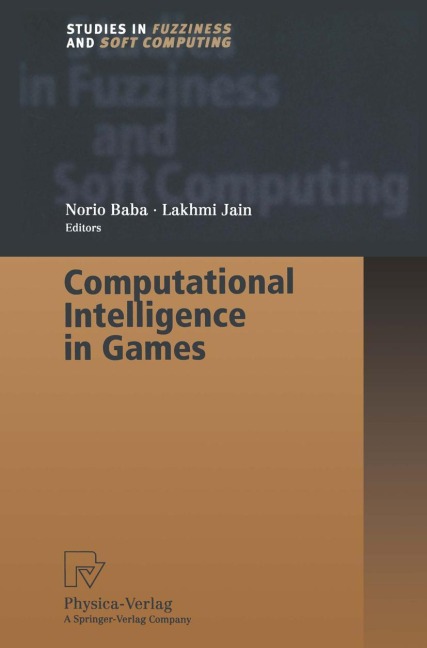
Computational Intelligence in Games -
-20% with code BOOKS
Shipping in 12-18 days
30-day return policy
The most powerful computers in the world are not only used for scientific research, defence, and business, but also in game playing. Computer games are a multi-billion dollar industry. Recent advances in computational intelligence paradigms have generated tremendous interest among researchers in the theory and implementation of games. Game theory is a branch of operational research dealing with decision the ... Full description
You May Also Like
 TOP
TOP

The Demon-Haunted World: Science as a Candle in the Dark
-20% with code BOOKS
In stock at our supplier
TOP

Many Faces, One Purpose: A Managers Handbook on Women in Firefighting
U. S. Fire Administration, Homeland Security
-20% with code BOOKS
Out of stock
TOP

The Gulf Moment: Arab Relations Since 2011
Florence Gaub, U. S. Army War College, Strategic Studies Institute
-20% with code BOOKS
Out of stock
 TOP
TOP

Introduction to Algorithms
Ronald L. Rivest, Charles E. Leiserson, Clifford Stein, Thomas H. Cormen
-20% with code BOOKS
In stock at our supplier
TOP

Thinking in Systems: International Bestseller
-20% with code BOOKS
In stock at our supplier
TOP


Integrating Special Forces and the ATLAS Network: A Theoretical Framework for Strategic Security Cooperation in Europe
-20% with code BOOKS
In stock at our supplier
TOP

The Code Book: The Science of Secrecy from Ancient Egypt to Quantum Cryptography
-20% with code BOOKS
In stock at our supplier
TOP

Skin in the Game: Hidden Asymmetries in Daily Life
-20% with code BOOKS
In stock at our supplier
TOP

Dinosaurs and Prehistoric Life: The Definitive Visual Guide to Prehistoric Animals
-20% with code BOOKS
In stock at our supplier
 TOP
TOP

International Economics: Theory and Policy, Global Edition
Paul Krugman, Maurice Obstfeld, Marc Melitz
-20% with code BOOKS
In stock at our supplier
TOP

The Unaccountability Machine: Why Big Systems Make Terrible Decisions
-20% with code BOOKS
In stock at our supplier
TOP

Crossing Borders: About the birth of the Consortium of European Research Libraries, the organisation's early years and its path to maturity, spanning the period from the late twentieth century to the first decades of the twenty-first century
-20% with code BOOKS
In stock at our supplier
TOP

Cybernetics: Second Edition: Or the Control and Communication in the Animal and the Machine
-20% with code BOOKS
In stock at our supplier
TOP

101 Things I Learned in Architecture School
-20% with code BOOKS
In stock at our supplier
 TOP
TOP

The Dictionary of Obscure Sorrows
-20% with code BOOKS
In stock at our supplier
TOP

Einhundert Zitate Female Edition: Ein Postkartenbuch mit 100 Zitaten
-20% with code BOOKS
In stock at our supplier

Description
The most powerful computers in the world are not only used for scientific research, defence, and business, but also in game playing. Computer games are a multi-billion dollar industry. Recent advances in computational intelligence paradigms have generated tremendous interest among researchers in the theory and implementation of games. Game theory is a branch of operational research dealing with decision theory in a competitive situation. Game theory involves the mathematical calculations and heuristics to optimize the efficient lines of play. This book presents a sample of the most recent research on the application of computational intelligence techniques in games. This book contains 7 chapters. The first chapter, by Chen, Fanelli, Castellano, and Jain, is an introduction to computational intelligence paradigms. It presents the basics of the main constituents of compu tational intelligence paradigms including knowledge representation, probability-based approaches, fuzzy logic, neural networks, genetic algorithms, and rough sets. In the second chapter, Chellapilla and Fogel present the evolution of a neural network to play checkers without human expertise. This chapter focuses on the use of a population of neural networks, where each network serves as an evaluation function to describe the quality of the current board position. After only a little more than 800 generations, the evolutionary process has generated a neural network that can play checkers at the expert level as designated by the u.s. Chess Federation rating system. The program developed by the authors has also competed well against commercially available software.
More Information
| Publisher | Physica-Verlag HD |
|---|---|
| Series | Studies in Fuzziness and Soft Computing |
| Release year | 2012 |
| Cover type | Softcover |
| EAN | 9783662003695 |