
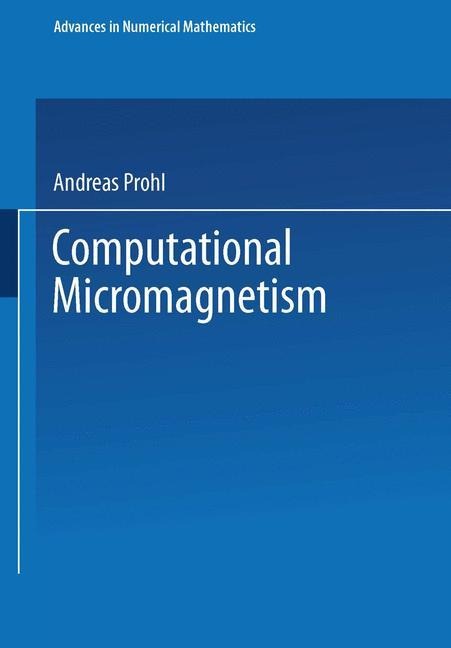
Computational Micromagnetism - Andreas Prohl
-20% with code BOOKS
Shipping in 12-18 days
30-day return policy
In this work, we study numerical issues related to a common mathematical model which describes ferromagnetic materials, both in a stationary and non stationary context. Electromagnetic effects are accounted for in an extended model to study nonstationary magneto-electronics. The last part deals with the numerical analysis of the commonly used Ericksen-Leslie model to study the fluid flow of nematic liquid ... Full description
You May Also Like

 TOP
TOP

INCOSE Systems Engineering Handbook
-20% with code BOOKS
In stock at our supplier
TOP
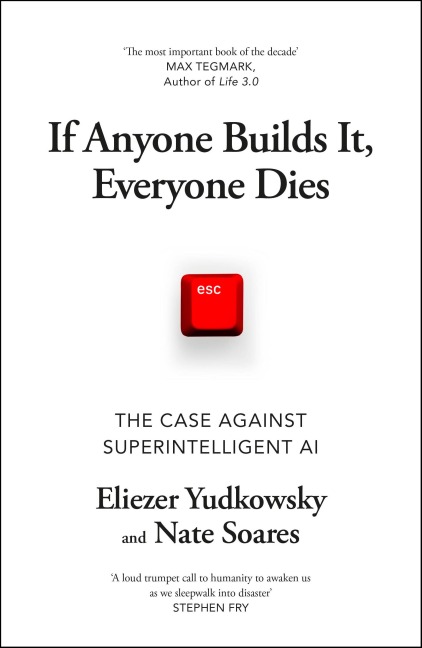
If Anyone Builds It, Everyone Dies: The Case Against Superintelligent AI
Eliezer Yudkowsky, Nate Soares
-20% with code BOOKS
In stock at our supplier
 TOP
TOP

Open Circuits: The Inner Beauty of Electronic Components
Eric Schlaepfer, Windell Oskay
-20% with code BOOKS
In stock at our supplier
TOP

Get started with MicroPython on Raspberry Pi Pico: The Official Raspberry Pi Pico Guide
-20% with code BOOKS
In stock at our supplier
TOP

Practical Electronics for Inventors
-20% with code BOOKS
In stock at our supplier
TOP

Nucleo Boards Programming with the STM32CubeIDE: Hands-on in more than 50 projects
-20% with code BOOKS
In stock at our supplier
TOP
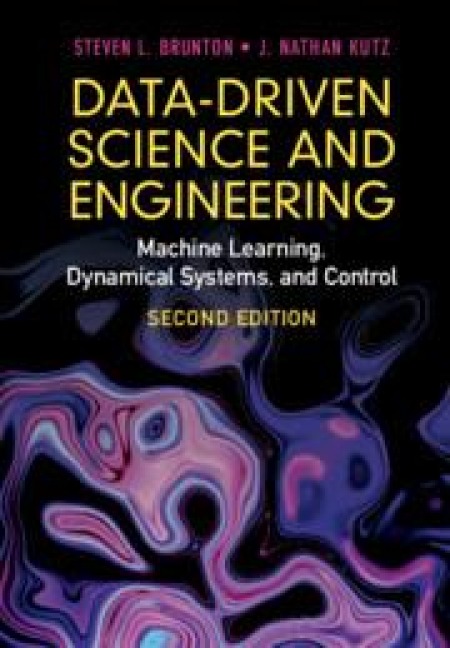
Data-Driven Science and Engineering: Machine Learning, Dynamical Systems, and Control
Steven L. Brunton, J. Nathan Kutz
-20% with code BOOKS
In stock at our supplier
TOP

Fundamentals of Aerodynamics ISE
Christopher Cadou, John D. Anderson
-20% with code BOOKS
In stock at our supplier
TOP

Black Holes: The Key to Understanding the Universe
-20% with code BOOKS
In stock at our supplier
TOP

KiCad Like A Pro - Fundamentals and Projects: Getting started with the world's best open-source PCB tool
-20% with code BOOKS
In stock at our supplier
TOP

How To Read Water: Clues & Patterns from Puddles to the Sea
-20% with code BOOKS
In stock at our supplier
TOP

Foundations of Flavor: The Noma Guide to Fermentation: Including Step-By-Step Information on Making and Cooking with: Koji, Kombuchas, Shoyus, Misos, Vinegars, Garums, Lacto-Ferments and black Fruits Vegetables
-20% with code BOOKS
In stock at our supplier
TOP

Make: Electronics: Learning by Discovery: A hands-on primer for the new electronics enthusiast
-20% with code BOOKS
In stock at our supplier
TOP

The Idea Factory: Bell Labs and the Great Age of American Innovation
-20% with code BOOKS
In stock at our supplier
TOP

Flowers For Algernon: A Modern Literary Classic
-20% with code BOOKS
In stock at our supplier
 TOP
TOP


Professional SMD Assembly: Practical Low-Cost Methods for Reliable PCB Production
-20% with code BOOKS
In stock at our supplier
TOP

Blood in the Machine: The Origins of the Rebellion Against Big Tech
-20% with code BOOKS
In stock at our supplier
Description
In this work, we study numerical issues related to a common mathematical model which describes ferromagnetic materials, both in a stationary and non stationary context. Electromagnetic effects are accounted for in an extended model to study nonstationary magneto-electronics. The last part deals with the numerical analysis of the commonly used Ericksen-Leslie model to study the fluid flow of nematic liquid crystals which find applications in display technologies, for example. All these mathematical models to describe different microstructural phe nomena share common features like (i) strong nonlinearities, and (ii) non convex side constraints (i.e., I m I = 1, almost everywhere in w C JRd, for the order parameter m : w -+ JRd). One key issue in numerical modeling of such problems is to make sure that the non-convex constraint is fulfilled for computed solutions. We present and analyze different solution strategies to deal with the variational problem of stationary micromagnetism, which builds part I of the book: direct minimization, convexification, and relaxation using Young measure-valued solutions. In particular, we address the following points: ¿ Direct minimization: A spatial triangulation 'generates an artificial exchange energy contribution' in the discretized minimizing problem which may pollute physically relevant exchange energy contributions; its minimizers exhibit multiple scales (with branching structures near the boundary of the ferromagnet) and are difficult to be computed efficiently. We exploit this observation to construct an adaptive scheme which better resolves multiple scale structures (cubic ferromagnets).
More Information
| Author | Andreas Prohl |
|---|---|
| Publisher | Vieweg+Teubner Verlag |
| Series | Advances in Numerical Mathematics |
| Release year | 2001 |
| Cover type | Softcover |
| EAN | 9783519003588 |