
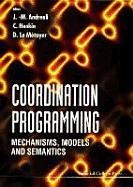
Coordination Programming: Mechanisms, Models and Semantics -
-20% with code BOOKS
30-day return policy
Coordination, considered abstractly, is an ubiquitous notion in computer science: for example, programming languages coordinate elementary instructions; operating systems coordinate accesses to hardware resources; database transaction schedulers coordinate accesses to shared data; etc. All these situations have some common features, which can be identified at the abstract level as "coordination mechanisms". ... Full description
Description
Coordination, considered abstractly, is an ubiquitous notion in computer science: for example, programming languages coordinate elementary instructions; operating systems coordinate accesses to hardware resources; database transaction schedulers coordinate accesses to shared data; etc. All these situations have some common features, which can be identified at the abstract level as "coordination mechanisms". This book focuses on a class of coordination models where multiple pieces of software coordinate their activities through some shared dataspace. The book has three parts. Part 1 presents the main coordination models studied in this book (Gamma, LO, TAO, LambdaN). Part 2 focuses on various semantics aspects of coordination, applied mainly to Gamma. Part 3 presents actual implementations of coordination models and an application.
More Information
| Publisher | Imperial College Press |
|---|---|
| Release year | 1996 |
| Cover type | Hardcover |
| EAN | 9781860940231 |