
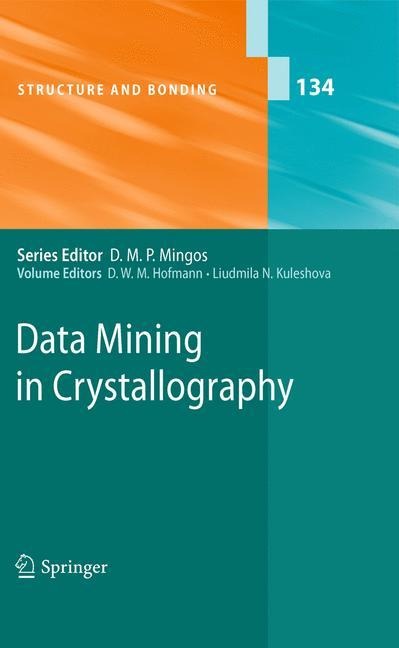
Data Mining in Crystallography -
-20% with code BOOKS
Shipping in 17-23 days
30-day return policy
Humans have been ¿manually¿ extracting patterns from data for centuries, but the increasing volume of data in modern times has called for more automatic approaches. Early methods of identifying patterns in data include Bayes¿ theorem (1700s) and Regression analysis (1800s). The proliferation, ubiquity and incre- ing power of computer technology has increased data collection and storage. As data sets have gr ... Full description
You May Also Like

 TOP
TOP

INCOSE Systems Engineering Handbook
-20% with code BOOKS
In stock at our supplier
TOP
If Anyone Builds It, Everyone Dies: The Case Against Superintelligent AI
Eliezer Yudkowsky, Nate Soares
-20% with code BOOKS
In stock at our supplier
 TOP
TOP

Open Circuits: The Inner Beauty of Electronic Components
Eric Schlaepfer, Windell Oskay
-20% with code BOOKS
In stock at our supplier
TOP

Get started with MicroPython on Raspberry Pi Pico: The Official Raspberry Pi Pico Guide
-20% with code BOOKS
In stock at our supplier
TOP

Practical Electronics for Inventors
-20% with code BOOKS
In stock at our supplier
TOP

Nucleo Boards Programming with the STM32CubeIDE: Hands-on in more than 50 projects
-20% with code BOOKS
In stock at our supplier
TOP
Data-Driven Science and Engineering: Machine Learning, Dynamical Systems, and Control
Steven L. Brunton, J. Nathan Kutz
-20% with code BOOKS
In stock at our supplier
TOP

Fundamentals of Aerodynamics ISE
Christopher Cadou, John D. Anderson
-20% with code BOOKS
In stock at our supplier
TOP

Black Holes: The Key to Understanding the Universe
-20% with code BOOKS
In stock at our supplier
TOP

KiCad Like A Pro - Fundamentals and Projects: Getting started with the world's best open-source PCB tool
-20% with code BOOKS
In stock at our supplier
TOP

How To Read Water: Clues & Patterns from Puddles to the Sea
-20% with code BOOKS
In stock at our supplier
TOP

Foundations of Flavor: The Noma Guide to Fermentation: Including Step-By-Step Information on Making and Cooking with: Koji, Kombuchas, Shoyus, Misos, Vinegars, Garums, Lacto-Ferments and black Fruits Vegetables
-20% with code BOOKS
In stock at our supplier
TOP

Make: Electronics: Learning by Discovery: A hands-on primer for the new electronics enthusiast
-20% with code BOOKS
In stock at our supplier
TOP
The Idea Factory: Bell Labs and the Great Age of American Innovation
-20% with code BOOKS
In stock at our supplier
TOP

Flowers For Algernon: A Modern Literary Classic
-20% with code BOOKS
In stock at our supplier
 TOP
TOP


Professional SMD Assembly: Practical Low-Cost Methods for Reliable PCB Production
-20% with code BOOKS
In stock at our supplier
TOP

Blood in the Machine: The Origins of the Rebellion Against Big Tech
-20% with code BOOKS
In stock at our supplier
Description
Humans have been ¿manually¿ extracting patterns from data for centuries, but the increasing volume of data in modern times has called for more automatic approaches. Early methods of identifying patterns in data include Bayes¿ theorem (1700s) and Regression analysis (1800s). The proliferation, ubiquity and incre- ing power of computer technology has increased data collection and storage. As data sets have grown in size and complexity, direct hands-on data analysis has - creasingly been augmented with indirect, automatic data processing. Data mining has been developed as the tool for extracting hidden patterns from data, by using computing power and applying new techniques and methodologies for knowledge discovery. This has been aided by other discoveries in computer science, such as Neural networks, Clustering, Genetic algorithms (1950s), Decision trees (1960s) and Support vector machines (1980s). Data mining commonlyinvolves four classes of tasks: ¿ Classi cation: Arranges the data into prede ned groups. For example, an e-mail program might attempt to classify an e-mail as legitimate or spam. Common algorithmsinclude Nearest neighbor,Naive Bayes classi er and Neural network. ¿ Clustering: Is like classi cation but the groups are not prede ned, so the algorithm will try to group similar items together. ¿ Regression: Attempts to nd a function which models the data with the least error. A common method is to use Genetic Programming. ¿ Association rule learning: Searches for relationships between variables. For example, a supermarket might gather data of what each customer buys.
More Information
| Publisher | Springer Berlin Heidelberg |
|---|---|
| Series | Structure and Bonding |
| Release year | 2009 |
| Cover type | Hardcover |
| EAN | 9783642047589 |