
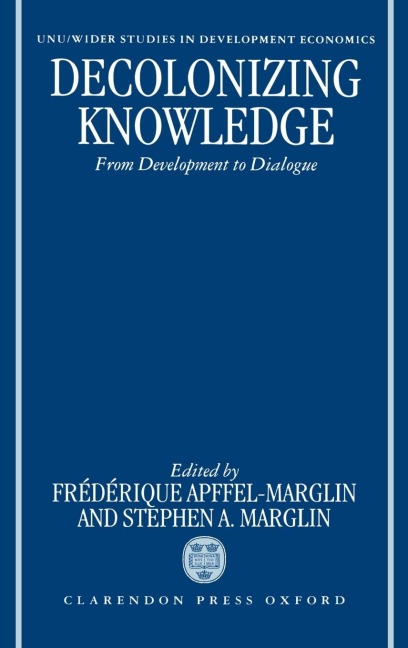
Decolonizing Knowledge: From Development to Dialogue - Marglin Apffel-Marglin,World Institute for Development Economic
-20% with code BOOKS
Shipping in 17-23 days
30-day return policy
Development failures, environmental degradation, and social fragmentation can no longer be regarded as side-effects or 'externalities'. They are the toxic consequences of pretensions that the modern Western view of knowledge is a universal neutral view, applicable to all people at all times. The very word 'development' and its cognates 'underdevelopment' and 'developing' confidently mark the 'first world' a ... Full description
Description
Development failures, environmental degradation, and social fragmentation can no longer be regarded as side-effects or 'externalities'. They are the toxic consequences of pretensions that the modern Western view of knowledge is a universal neutral view, applicable to all people at all times. The very word 'development' and its cognates 'underdevelopment' and 'developing' confidently mark the 'first world' as the future of the 'third'. This book argues that the linear evolutionary paradigm of development that comes out of the modern Western view of knowledge is a contemporary form of colonialism. The authors - covering topics as diverse as the theory of knowledge underlying the work of John Maynard Keynes, what the renowned British geneticist J. B. S. Haldane was looking for when he migrated to India, and the knowledge of Mexican and Indian peasants - propose a pluralistic vision and a decolonization of knowledge: the replacement of one-way transfers of knowledge and technology by dialogue and mutual learning.
More Information
| Author | Marglin Apffel-Marglin, World Institute for Development Economic |
|---|---|
| Publisher | Clarendon Press |
| Release year | 1996 |
| Cover type | Hardcover |
| EAN | 9780198288848 |