
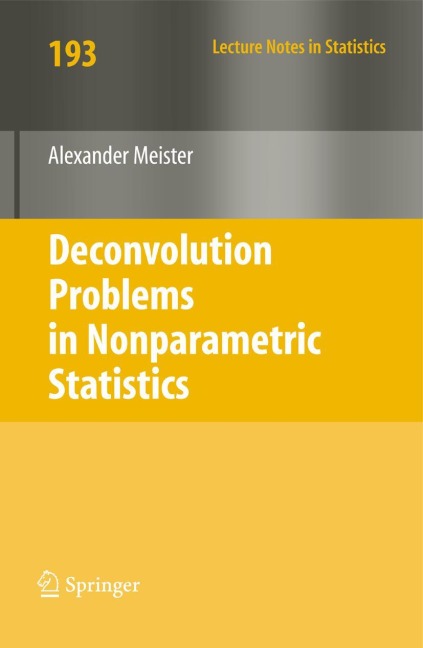
Deconvolution Problems in Nonparametric Statistics - Alexander Meister
-20% with code BOOKS
Shipping in 12-18 days
30-day return policy
Deconvolution problems occur in many ?elds of nonparametric statistics, for example, density estimation based on contaminated data, nonparametric - gression with errors-in-variables, image and signal deblurring. During the last two decades, those topics have received more and more attention. As appli- tions of deconvolution procedures concern many real-life problems in eco- metrics, biometrics, medical stat ... Full description
You May Also Like
 TOP
TOP

Six Not-so-easy Pieces: Einstein's Relativity, Symmetry, and Space-Time
Richard P. Feynman, Robert B. Leighton, Matthew Sands
-20% with code BOOKS
In stock at our supplier
TOP

Six Easy Pieces: Essentials of Physics Explained by Its Most Brilliant Teacher
Richard P. Feynman, Robert B. Leighton, Matthew Sands
-20% with code BOOKS
In stock at our supplier
TOP

Behave: The Biology of Humans at Our Best and Worst
-20% with code BOOKS
In stock at our supplier
TOP
Why Machines Learn: The Elegant Maths Behind Modern AI
-20% with code BOOKS
In stock at our supplier
TOP


The Age of Alchemy: How Early Innovators Shaped Modern Chemistry
-20% with code BOOKS
In stock at our supplier
TOP

The Secrets of our DNA: How Genetics has Changed the World
-20% with code BOOKS
In stock at our supplier
TOP

Why We Sleep: Unlocking the Power of Sleep and Dreams
-20% with code BOOKS
In stock
TOP

Factfulness: Ten Reasons We're Wrong About the World--and Why Things Are Better Than You Think
Ola Rosling, Anna Rosling Rönnlund, Hans Rosling
-20% with code BOOKS
In stock at our supplier
TOP

Astrophysics for People in a Hurry: Essays on the Universe and Our Place Within It
-20% with code BOOKS
In stock at our supplier
TOP

The Rise and Fall of the Dinosaurs: A New History of a Lost World
-20% with code BOOKS
In stock at our supplier
TOP

The Rise and Reign of the Mammals: A New History, from the Shadow of the Dinosaurs to Us
-20% with code BOOKS
In stock at our supplier
TOP

Determined: The Science of Life Without Free Will
-20% with code BOOKS
In stock at our supplier
TOP
Learn Faster, Perform Better: A Musician's Guide to the Neuroscience of Practicing
-20% with code BOOKS
In stock at our supplier
TOP

Beyond Inheritance: Our Ever-Mutating Cells and a New Understanding of Health
-20% with code BOOKS
In stock at our supplier
 TOP
TOP

The Feynman Lectures on Physics. The New Millennium Edition
Matthew Sands, Robert Leighton, Richard Feynman
-20% with code BOOKS
In stock at our supplier
TOP

How to Solve it: A New Aspect of Mathematical Method
-20% with code BOOKS
In stock at our supplier
TOP

Thing Explainer: Complicated Stuff in Simple Words
-20% with code BOOKS
In stock at our supplier
TOP

Introduction to Quantum Mechanics
Darrell F. Schroeter, David J. Griffiths
-20% with code BOOKS
In stock at our supplier
TOP

How Far the Light Reaches: A Life in Ten Sea Creatures
-20% with code BOOKS
In stock at our supplier
Description
Deconvolution problems occur in many ?elds of nonparametric statistics, for example, density estimation based on contaminated data, nonparametric - gression with errors-in-variables, image and signal deblurring. During the last two decades, those topics have received more and more attention. As appli- tions of deconvolution procedures concern many real-life problems in eco- metrics, biometrics, medical statistics, image reconstruction, one can realize an increasing number of applied statisticians who are interested in nonpa- metric deconvolution methods; on the other hand, some deep results from Fourier analysis, functional analysis, and probability theory are required to understand the construction of deconvolution techniques and their properties so that deconvolution is also particularly challenging for mathematicians. Thegeneraldeconvolutionprobleminstatisticscanbedescribedasfollows: Our goal is estimating a function f while any empirical access is restricted to some quantity h = f?G = f(x?y)dG(y), (1. 1) that is, the convolution of f and some probability distribution G. Therefore, f can be estimated from some observations only indirectly. The strategy is ¿ estimating h ?rst; this means producing an empirical version h of h and, then, ¿ applying a deconvolution procedure to h to estimate f. In the mathematical context, we have to invert the convolution operator with G where some reg- ¿ ularization is required to guarantee that h is contained in the invertibility ¿ domain of the convolution operator. The estimator h has to be chosen with respect to the speci?c statistical experiment.
More Information
| Author | Alexander Meister |
|---|---|
| Publisher | Springer Berlin Heidelberg |
| Series | Lecture Notes in Statistics |
| Release year | 2009 |
| Cover type | Softcover |
| EAN | 9783540875567 |