
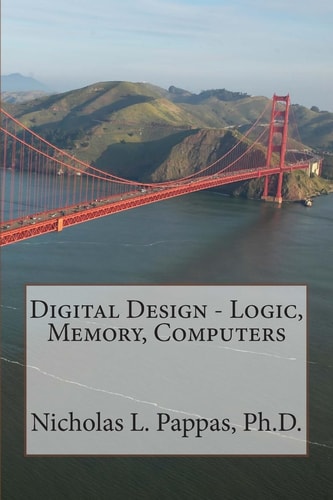
Digital Design - Logic, Memory, Computers - Nicholas L. Pappas
-20% with code BOOKS
Shipping in 10-16 days
30-day return policy
Electrical and Electronic Engineering Design Series Volume 3 This university level Electrical Engineering text is for anyone who wants to know how to design products using digital logic circuits. The present text is unusually accessible to readers who want to acquire the skills of digital design. We present a thorough foundation so that you can proceed to learn how to design any digital system. This text is ... Full description
You May Also Like


 TOP
TOP

If Anyone Builds It, Everyone Dies: The Case Against Superintelligent AI
Eliezer Yudkowsky, Nate Soares
-20% with code BOOKS
In stock at our supplier
TOP


We Are Not Machines: The Fight for the Future of Work
-20% with code BOOKS
Out of stock
TOP
Open Circuits: The Inner Beauty of Electronic Components
Eric Schlaepfer, Windell Oskay
-20% with code BOOKS
In stock at our supplier
TOP
Get started with MicroPython on Raspberry Pi Pico: The Official Raspberry Pi Pico Guide
-20% with code BOOKS
In stock at our supplier
TOP
Practical Electronics for Inventors
-20% with code BOOKS
In stock at our supplier
TOP

Nucleo Boards Programming with the STM32CubeIDE: Hands-on in more than 50 projects
-20% with code BOOKS
In stock at our supplier
TOP
Data-Driven Science and Engineering: Machine Learning, Dynamical Systems, and Control
Steven L. Brunton, J. Nathan Kutz
-20% with code BOOKS
In stock at our supplier
 TOP
TOP

Fundamentals of Aerodynamics ISE
Christopher Cadou, John D. Anderson
-20% with code BOOKS
In stock at our supplier
TOP

Black Holes: The Key to Understanding the Universe
-20% with code BOOKS
In stock at our supplier
TOP
KiCad Like A Pro - Fundamentals and Projects: Getting started with the world's best open-source PCB tool
-20% with code BOOKS
In stock at our supplier
TOP

Foundations of Flavor: The Noma Guide to Fermentation: Including Step-By-Step Information on Making and Cooking with: Koji, Kombuchas, Shoyus, Misos, Vinegars, Garums, Lacto-Ferments and black Fruits Vegetables
-20% with code BOOKS
In stock at our supplier
TOP
Make: Electronics: Learning by Discovery: A hands-on primer for the new electronics enthusiast
-20% with code BOOKS
In stock at our supplier
TOP

The Idea Factory: Bell Labs and the Great Age of American Innovation
-20% with code BOOKS
In stock at our supplier
TOP

Flowers For Algernon: A Modern Literary Classic
-20% with code BOOKS
In stock at our supplier
TOP
Professional SMD Assembly: Practical Low-Cost Methods for Reliable PCB Production
-20% with code BOOKS
In stock at our supplier
TOP

Blood in the Machine: The Origins of the Rebellion Against Big Tech
-20% with code BOOKS
In stock at our supplier
TOP

Mastering the Arduino Uno R4: Programming and Projects for the Minima and WiFi
-20% with code BOOKS
In stock at our supplier
Description
This university level Electrical Engineering text is for anyone who wants to know how to design products using digital logic circuits. The present text is unusually accessible to readers who want to acquire the skills of digital design. We present a thorough foundation so that you can proceed to learn how to design any digital system.
This text is different from the many introductory digital design texts, because we actually design a product by implementing a design and not just talk about logic circuits used in a digital circuit. And, we ask you to work hard doing experiments so that you acquire real world experience with commercially available digital circuits. In other words this is about real learning.
We start at the beginning by presenting a top down design method for digital systems.
We learn about three basic tools necessary to execute any digital design - Truth Tables, Karnaugh maps, and Switching Algebra.
The basic circuits of digital logic are building blocks without memory. They are standard commercially available logic circuits, which are described and their equations are presented. We only use standard products. Furthermore we show how to use mixed logic that simplifies digital design.
The ASM (algorithmic state machine) chart, a fourth tool, is the preferred way to implement the algorithm representing the product you want to design. We show how to implement ASM charts, derive truth tables from them, and how to convert the truth tables to digital circuits. The ASM-chart-to-product process is straightforward.
The design of complex building blocks with memory is based on elementary blocks with one bit memory also known as flip-flops. Designs are implemented by the ASM method. We show how to use ASM's to design up and up/down synchronous counters, shift registers, and linear feedback shift registers using standard products.
This is followed by showing how to design memory systems with and without a cache hierarchy. We explain, and then show how to add error correction and control to the memory system. ASM charts and associated timing diagrams allow us to readily implement the designs. These are charts and timing diagrams we have not found anywhere else.
A computer has two basic parts - computer control and a datapath for executing instructions. We define a user instruction set (uI), the uI address modes, and how the uI are formatted as binary words. Status bits NCZV and their condition codes that implement program control are defined. We show how each uI is represented by a list of micro instructions mI that is executed by the datapath, and how the datapath executes the mI.
For large circuit designs text capture of digital designs is preferred to schematic capture. Verilog uses text capture to represent digital circuits with a hierarchy of modules that are interconnected via input and output ports. We show by example how to write modules defining digital circuits so that you can move on to multi 1,000 gate chip designs using Verilog, which is a hardware description language (HDL).
The presentations are eminently clear, because they are based on the policies assume nothing and nothing is obvious.
The present text's contents are topics one actually uses when engaged in digital circuit analysis and design.
Eight experiments are included that give life to the text's contents, and provide the reader with real world experience with making measurements, using instruments, and learning about all kinds of parts. We consider the experiments to be significant learning activities.
More Information
| Author | Nicholas L. Pappas |
|---|---|
| Publisher | CreateSpace Independent Publishing Platform |
| Release year | 2014 |
| Cover type | Softcover |
| EAN | 9781499266764 |