
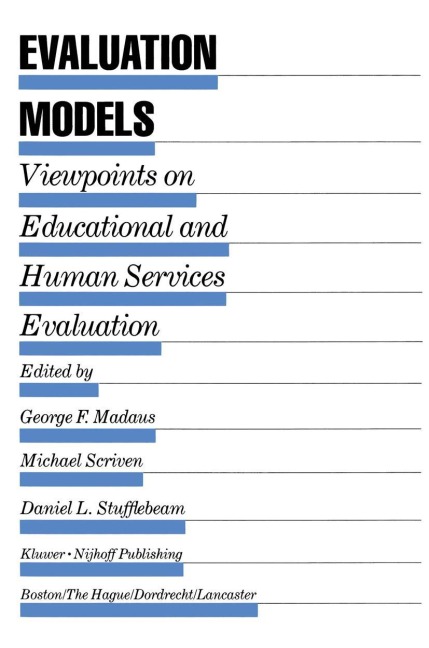
Evaluation Models: Viewpoints on Educational and Human Services Evaluation -
-30% with code BOOKS
Shipping in 12-18 days
30-day return policy
Attempting fonnally to evaluate something involves the evaluator coming to grips with a number of abstract concepts such as value, merit, worth, growth, criteria, standards, objectives, needs, nonns, client, audience, validity, reliability, objectivity, practical significance, accountability, improvement, process, pro duct, fonnative, summative, costs, impact, infonnation, credibility, and - of course - wi ... Full description
You May Also Like
 TOP
TOP

The Culture Map: Breaking Through the Invisible Boundaries of Global Business
-30% with code BOOKS
In stock
TOP

Atomic Habits: An Easy & Proven Way to Build Good Habits & Break Bad Ones
-30% with code BOOKS
In stock
TOP


The Nord Stream Conspiracy: The Inside Story of the Explosions That Shook the World
-30% with code BOOKS
In stock at our supplier
TOP

Women Who Run with the Wolves: Myths and Stories of the Wild Woman Archetype
Clarissa Pinkola Estés, Clarissa Pinkola Estes
-30% with code BOOKS
In stock at our supplier
TOP
Sapiens: A Brief History of Humankind
-30% with code BOOKS
In stock at our supplier
TOP
How Democracies Die
Steven Levitsky, Daniel Ziblatt
-30% with code BOOKS
In stock at our supplier
 TOP
TOP

Prisoners of Geography: Updated 10th Anniversary Edition: Ten Maps That Tell You Everything You Need To Know About Global Politics
-30% with code BOOKS
In stock at our supplier
TOP

Classic Football Shirts
Classic Football Shirts, Rory Smith
-30% with code BOOKS
In stock at our supplier
 TOP
TOP

The Whole-Brain Child: 12 Revolutionary Strategies to Nurture Your Child's Developing Mind
Daniel J. Siegel, Tina Payne Bryson
-30% with code BOOKS
In stock at our supplier

 TOP
TOP
Everything I Know About Love: Now a Major BBC One Series
-30% with code BOOKS
In stock
TOP

Braiding Sweetgrass: Indigenous Wisdom, Scientific Knowledge and the Teachings of Plants
-30% with code BOOKS
In stock at our supplier
TOP

The Unabridged Journals of Sylvia Plath
-30% with code BOOKS
In stock at our supplier
TOP

To Kill a Mockingbird. 60th Anniversary Edition
-30% with code BOOKS
In stock at our supplier
 TOP
TOP
Caliban and the Witch: Women, the Body and Primitive Accumulation
-30% with code BOOKS
In stock at our supplier
TOP

Breaking Through: My Life in Science
-30% with code BOOKS
In stock at our supplier
Description
Attempting fonnally to evaluate something involves the evaluator coming to grips with a number of abstract concepts such as value, merit, worth, growth, criteria, standards, objectives, needs, nonns, client, audience, validity, reliability, objectivity, practical significance, accountability, improvement, process, pro duct, fonnative, summative, costs, impact, infonnation, credibility, and - of course - with the tenn evaluation itself. To communicate with colleagues and clients, evaluators need to clarify what they mean when they use such tenns to denote important concepts central to their work. Moreover, evaluators need to integrate these concepts and their meanings into a coherent framework that guides all aspects of their work. If evaluation is to lay claim to the mantle of a profession, then these conceptualizations of evaluation must lead to the conduct of defensible evaluations. The conceptualization of evaluation can never be a one-time activity nor can any conceptualization be static. Conceptualizations that guide evaluation work must keep pace with the growth of theory and practice in the field. Further, the design and conduct of any particular study involves a good deal of localized conceptualization.
More Information
| Publisher | Springer Netherlands |
|---|---|
| Series | Evaluation in Education and Human Services |
| Release year | 2011 |
| Cover type | Softcover |
| EAN | 9789400966710 |