
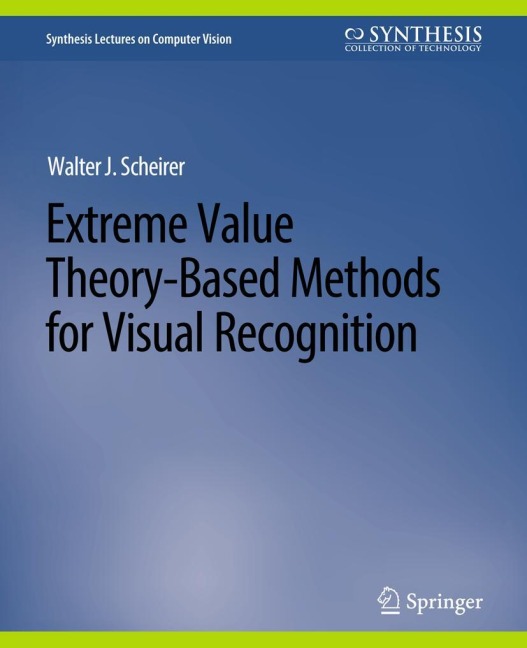
Extreme Value Theory-Based Methods for Visual Recognition - Walter J. Scheirer
-20% with code BOOKS
Shipping in 12-18 days
30-day return policy
A common feature of many approaches to modeling sensory statistics is an emphasis on capturing the "average." From early representations in the brain, to highly abstracted class categories in machine learning for classification tasks, central-tendency models based on the Gaussian distribution are a seemingly natural and obvious choice for modeling sensory data. However, insights from neuroscience, psycholog ... Full description
You May Also Like
 TOP
TOP

Gödel, Escher, Bach: An Eternal Golden Braid
-20% with code BOOKS
In stock at our supplier
TOP

Hackers. 25th Anniversary Edition: Heroes of the Computer Revolution
-20% with code BOOKS
In stock at our supplier
TOP

The Web Application Hacker's Handbook: Discovering and Exploiting Security Flaws
-20% with code BOOKS
In stock at our supplier
TOP

The Pragmatic Programmer: journey to mastery, 20th Anniversary Edition, 2/e: your journey to mastery, 20th Anniversary Edition
-20% with code BOOKS
In stock at our supplier
TOP

Mathematics for Machine Learning
Cheng Soon Ong, A. Aldo Faisal, Marc Peter Deisenroth
-20% with code BOOKS
In stock at our supplier
TOP

The Art of Game Design: A Book of Lenses
-20% with code BOOKS
In stock at our supplier
TOP

How Linux Works: What Every Superuser Should Know
-20% with code BOOKS
In stock at our supplier
TOP
Artificial Intelligence: A Modern Approach, Global Edition
-20% with code BOOKS
In stock at our supplier
TOP

Linux Basics for Hackers, 2nd Edition: Getting Started with Networking, Scripting, and Security in Kali
-20% with code BOOKS
In stock at our supplier
TOP

AI Engineering: Building Applications with Foundation Models
-20% with code BOOKS
In stock at our supplier
TOP

Fundamentals of Software Architecture: A Modern Engineering Approach
-20% with code BOOKS
In stock at our supplier
TOP
How To Think About AI: A Guide For The Perplexed
-20% with code BOOKS
In stock at our supplier
 TOP
TOP
Empire of AI: Dreams and Nightmares in Sam Altman's OpenAI
-20% with code BOOKS
In stock at our supplier
TOP
HBR Guide to Generative AI for Managers
-20% with code BOOKS
In stock at our supplier
TOP
Speak Data: Artists, Scientists, Thinkers, and Dreamers on How We Live Our Lives in Numbers
-20% with code BOOKS
In stock at our supplier
TOP

If Anyone Builds It, Everyone Dies: Why Superhuman AI Would Kill Us All
Eliezer Yudkowsky, Nate Soares
-20% with code BOOKS
In stock at our supplier
TOP


The Rust Programming Language
Steve Klabnik, Carol Nichols, Chris Krycho
-20% with code BOOKS
In stock at our supplier
TOP

AI for Good: How Real People Are Using Artificial Intelligence to Fix Things That Matter
-20% with code BOOKS
Out of stock
Description
A common feature of many approaches to modeling sensory statistics is an emphasis on capturing the "average." From early representations in the brain, to highly abstracted class categories in machine learning for classification tasks, central-tendency models based on the Gaussian distribution are a seemingly natural and obvious choice for modeling sensory data. However, insights from neuroscience, psychology, and computer vision suggest an alternate strategy: preferentially focusing representational resources on the extremes of the distribution of sensory inputs. The notion of treating extrema near a decision boundary as features is not necessarily new, but a comprehensive statistical theory of recognition based on extrema is only now just emerging in the computer vision literature. This book begins by introducing the statistical Extreme Value Theory (EVT) for visual recognition. In contrast to central-tendency modeling, it is hypothesized that distributions near decision boundaries form a more powerful model for recognition tasks by focusing coding resources on data that are arguably the most diagnostic features. EVT has several important properties: strong statistical grounding, better modeling accuracy near decision boundaries than Gaussian modeling, the ability to model asymmetric decision boundaries, and accurate prediction of the probability of an event beyond our experience. The second part of the book uses the theory to describe a new class of machine learning algorithms for decision making that are a measurable advance beyond the state-of-the-art. This includes methods for post-recognition score analysis, information fusion, multi-attribute spaces, and calibration of supervised machine learning algorithms.
More Information
| Author | Walter J. Scheirer |
|---|---|
| Publisher | Springer Nature Switzerland |
| Series | Synthesis Lectures on Computer Vision |
| Release year | 2017 |
| Cover type | Softcover |
| EAN | 9783031006890 |