
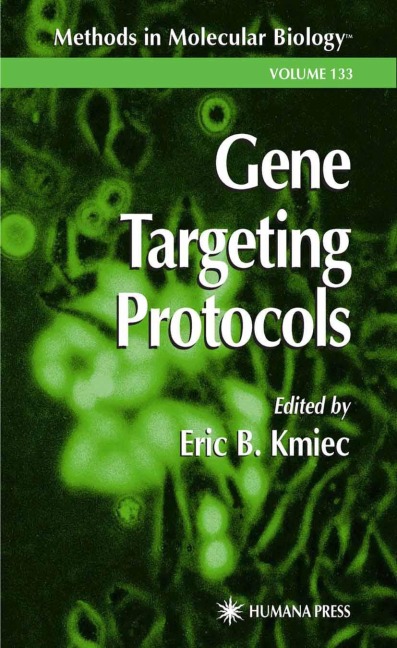
Gene Targeting Protocols -
-20% with code BOOKS
Shipping in 12-18 days
30-day return policy
The potential now exists in many experimental systems to transfer a cloned, modified gene back into the genome of the host organism. In the ideal situation, the cloned gene is returned to its homologous location in the genome and becomes inserted at the target locus. This process is a controlled means for the repair of DNA damage and ensures accurate chromosome disjunction during meiosis. The paradigm for t ... Full description
You May Also Like
 TOP
TOP

The Myth of Normal: Trauma, Illness, and Healing in a Toxic Culture
-20% with code BOOKS
In stock
TOP
No Bad Parts: Healing Trauma and Restoring Wholeness with the Internal Family Systems Model
-20% with code BOOKS
In stock at our supplier
TOP

Maybe You Should Talk to Someone: a therapist, her thearapist, and our lives revealed
-20% with code BOOKS
In stock at our supplier
TOP

On Connection: 'Powerful' MATT HAIG
-20% with code BOOKS
In stock at our supplier
TOP

The Checklist Manifesto: How to Get Things Right
-20% with code BOOKS
In stock at our supplier
TOP

Aids to the Examination of the Peripheral Nervous System
-20% with code BOOKS
In stock at our supplier
TOP
Harrison's Principles of Internal Medicine (Vol.1 & Vol.2)
Stephen Hauser, Joseph Loscalzo, Steven Holland, Dan Longo, J. Larry Jameson, Dennis Kasper, Carol Langford, Anthony Fauci
-20% with code BOOKS
In stock at our supplier
TOP
The Body Keeps the Score: Brain, Mind, and Body in the Healing of Trauma
-20% with code BOOKS
In stock at our supplier
 TOP
TOP

How Not To Die: Discover the foods scientifically proven to prevent and reverse disease
-20% with code BOOKS
In stock at our supplier
TOP
Lifespan: Why We Age - and Why We Don't Have To
-20% with code BOOKS
In stock at our supplier
TOP
Vademecum Metabolicum: Diagnosis and Treatment of Inborn Errors of Metabolism Forword by William L. Nyhan, San Diego, USA
Johannes Zschocke, Georg F. Hoffmann
-20% with code BOOKS
In stock at our supplier
TOP

ROAR: How to Match Your Food and Fitness to Your Unique Female Physiology for Optimum Performance, Great Health, and a Strong, Lean Body for Life
-20% with code BOOKS
In stock at our supplier
TOP

Cellular and Molecular Immunology
Sarah Henrickson, Abul K. Abbas, Andrew H. Lichtman, Shiv Pillai
-20% with code BOOKS
In stock at our supplier
TOP

The Autistic Burnout Workbook: Your Guide to Your Personal Recovery Plan
-20% with code BOOKS
In stock at our supplier
TOP

McGee's Evidence-Based Physical Diagnosis
-20% with code BOOKS
In stock at our supplier
TOP
Physics, Pharmacology and Physiology for Anaesthetists: Key Concepts for the FRCA
Matthew E. Cross, Emma V. E. Plunkett
-20% with code BOOKS
In stock at our supplier
TOP
Oxford Handbook of Clinical Medicine
Peter Hateley, Iain McGurgan, Ian B. Wilkinson, Tim Raine, Dearbhla Kelly, Kate Wiles
-20% with code BOOKS
In stock at our supplier
TOP
Pocket Guide to Teaching for Clinical Instructors
-20% with code BOOKS
In stock at our supplier
TOP
Oxford Handbook of Critical Care
Andrew Webb, Mervyn Singer, Alice Carter
-20% with code BOOKS
In stock at our supplier
Description
The potential now exists in many experimental systems to transfer a cloned, modified gene back into the genome of the host organism. In the ideal situation, the cloned gene is returned to its homologous location in the genome and becomes inserted at the target locus. This process is a controlled means for the repair of DNA damage and ensures accurate chromosome disjunction during meiosis. The paradigm for thinking about the mechanism of this p- cess has emerged primarily from two sources: (1) The principles of reaction mechanics have come from detailed biochemical analyses of the RecA protein purified from Escherichia coli; and (2) the principles of information transfer have been derived from genetic studies carried out in bacteriophage and fungi. A compelling picture of the process of homologous pairing and DNA strand exchange has been influential in directing investigators interested in gene t- geting experiments. The ability to find and pair homologous DNA molecules enables ac- rate gene targeting and is the central phenomenon underlying genetic recombi- tion. Biochemically, the overall process can be thought of as a series of steps in a reaction pathway whereby DNA molecules are brought into homologous register, the four-stranded Holliday structure intermediate is formed, hete- duplex DNA is extended, and DNA strands are exchanged. Not much is known about the biochemical pathway leading to homologous recombination in euka- otes.
More Information
| Publisher | Humana Press |
|---|---|
| Series | Methods in Molecular Biology |
| Release year | 2013 |
| Cover type | Softcover |
| EAN | 9781489941589 |