
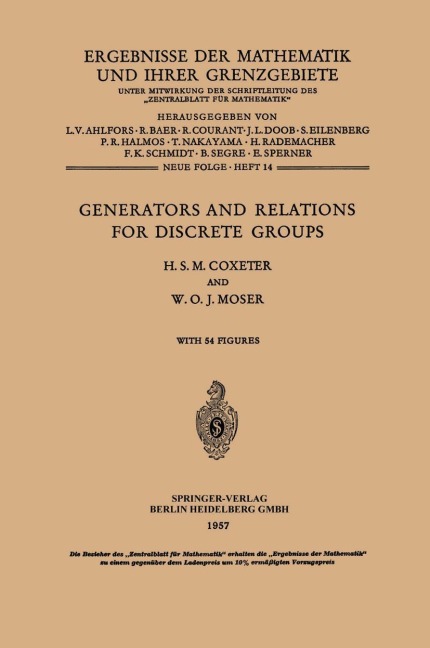
Generators and Relations for Discrete Groups - William O. J. Moser,Harold Scott Macdonald Coxeter
-20% with code BOOKS
Shipping in 12-18 days
30-day return policy
When we began to consider the scope of this book, we envisaged a catalogue supplying at least one abstract definition for any finitely generated group that the reader might propose. But we soon realized that more or less arbitrary restrictions are necessary, because interesting groups are so numerous. For permutation groups of degree 8 or less (i. e., subgroups of e ), the reader cannot do better than cons ... Full description
You May Also Like
 TOP
TOP

Determined: The Science of Life Without Free Will
-20% with code BOOKS
In stock at our supplier
 TOP
TOP

The Rise and Fall of the Dinosaurs: A New History of a Lost World
-20% with code BOOKS
In stock at our supplier
TOP

Factfulness: Ten Reasons We're Wrong About the World--and Why Things Are Better Than You Think
Ola Rosling, Anna Rosling Rönnlund, Hans Rosling
-20% with code BOOKS
In stock at our supplier
TOP

Biology: A Global Approach, Global Edition
Neil Campbell, Rebecca Orr, Lisa Urry, Peter Minorsky, Michael Cain, Jane Reece, Steven Wasserman
-20% with code BOOKS
In stock at our supplier
TOP

Six Not-so-easy Pieces: Einstein's Relativity, Symmetry, and Space-Time
Richard P. Feynman, Robert B. Leighton, Matthew Sands
-20% with code BOOKS
In stock at our supplier
TOP

Entangled Life: How Fungi Make Our Worlds, Change Our Minds and Shape Our Futures
-20% with code BOOKS
In stock at our supplier
TOP

The Light Eaters: How the Unseen World of Plant Intelligence Offers a New Understanding of Life on Earth
-20% with code BOOKS
In stock at our supplier
TOP


The Age of Alchemy: How Early Innovators Shaped Modern Chemistry
-20% with code BOOKS
In stock at our supplier
TOP

The Secrets of our DNA: How Genetics has Changed the World
-20% with code BOOKS
In stock at our supplier
TOP

Janeway's Immunobiology
Leslie J. Berg, Kenneth Murphy, Casey Weaver
-20% with code BOOKS
In stock at our supplier
TOP

Behave: The Biology of Humans at Our Best and Worst
-20% with code BOOKS
In stock at our supplier
TOP

Why We Sleep: Unlocking the Power of Sleep and Dreams
-20% with code BOOKS
In stock
TOP
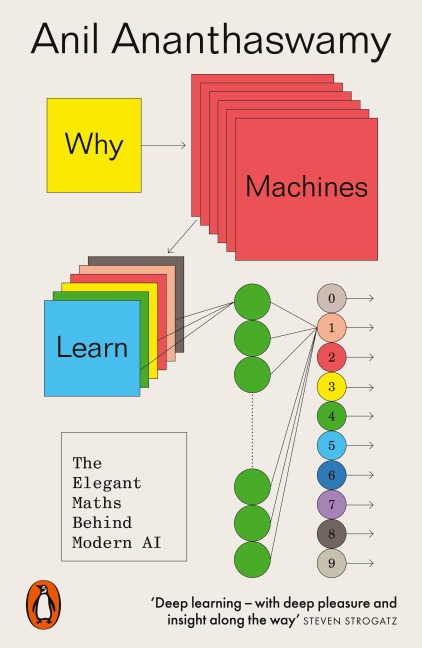
Why Machines Learn: The Elegant Maths Behind Modern AI
-20% with code BOOKS
In stock at our supplier
TOP

Life As No One Knows It: The Physics of Life's Emergence
-20% with code BOOKS
In stock at our supplier
TOP

The Rise and Reign of the Mammals: A New History, from the Shadow of the Dinosaurs to Us
-20% with code BOOKS
In stock at our supplier
TOP

Learn Faster, Perform Better: A Musician's Guide to the Neuroscience of Practicing
-20% with code BOOKS
In stock at our supplier
TOP

The Brain That Changes Itself: Stories of Personal Triumph from the Frontiers of Brain Science
-20% with code BOOKS
In stock at our supplier
 TOP
TOP

How to Solve it: A New Aspect of Mathematical Method
-20% with code BOOKS
In stock at our supplier
Description
When we began to consider the scope of this book, we envisaged a catalogue supplying at least one abstract definition for any finitely generated group that the reader might propose. But we soon realized that more or less arbitrary restrictions are necessary, because interesting groups are so numerous. For permutation groups of degree 8 or less (i. e., subgroups of e ), the reader cannot do better than consult the 8 tables of JosEPHINE BuRNS (1915), while keeping an eye open for misprints. Our own tables (on pages 134-143) deal with groups of low order, finiteandinfinite groups of congruent transformations, symmetric and alternating groups, linear fractional groups, and groups generated by reflections in real Euclidean space of any number of dimensions. The best substitute foramoreextensive catalogue is the description (in Chapter 2) of a method whereby the reader can easily work out his own abstract definition for almost any given finite group. This method is sufficiently mechanical for the use of an electronic computer. There is also a topological method (Chapter 3), suitable not only for groups of low order but also for some infinite groups. This involves choosing a set of generators, constructing a certain graph (the Cayley diagram or DEHNsehe Gruppenbild), and embedding the graph into a surface. Cases in which the surface is a sphere or a plane are described in Chapter 4, where we obtain algebraically, and verify topologically, an abstract definition for each of the 17 space groups of two-dimensional crystallography.
More Information
| Author | William O. J. Moser, Harold Scott Macdonald Coxeter |
|---|---|
| Publisher | Springer Berlin Heidelberg |
| Series | Ergebnisse der Mathematik und Ihrer Grenzgebiete. 1. Folge |
| Release year | 1957 |
| Cover type | Softcover |
| EAN | 9783662236543 |