
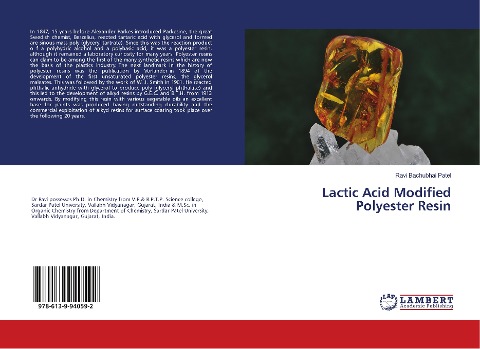
Lactic Acid Modified Polyester Resin - Ravi Bachubhai Patel
-20% with code BOOKS
Shipping in 15-21 days
30-day return policy
In 1847, 15 years before Alexander Parkes introduced Parkesine, the great Swedish chemist, Berzelius, reacted tartaric acid with glycerol and formed are sinous mass poly (glyceryl tartrate). Since this was the reaction product o f a polyhydric alcohol and a polybasic acid, it was a polyester resin, although it remained a laboratory curiosity for many years. Polyester resins can claim to be among the first o ... Full description
You May Also Like
 TOP
TOP

Determined: The Science of Life Without Free Will
-20% with code BOOKS
In stock at our supplier
TOP

The Light Eaters: How the Unseen World of Plant Intelligence Offers a New Understanding of Life on Earth
-20% with code BOOKS
In stock at our supplier
 TOP
TOP

Why We Sleep: Unlocking the Power of Sleep and Dreams
-20% with code BOOKS
In stock
TOP

The Rise and Fall of the Dinosaurs: A New History of a Lost World
-20% with code BOOKS
In stock at our supplier
TOP

Biology: A Global Approach, Global Edition
Neil Campbell, Rebecca Orr, Lisa Urry, Peter Minorsky, Michael Cain, Jane Reece, Steven Wasserman
-20% with code BOOKS
In stock at our supplier
TOP

Six Not-so-easy Pieces: Einstein's Relativity, Symmetry, and Space-Time
Richard P. Feynman, Robert B. Leighton, Matthew Sands
-20% with code BOOKS
In stock at our supplier
TOP


The Age of Alchemy: How Early Innovators Shaped Modern Chemistry
-20% with code BOOKS
In stock at our supplier
TOP

The Secrets of our DNA: How Genetics has Changed the World
-20% with code BOOKS
In stock at our supplier
TOP

Janeway's Immunobiology
Leslie J. Berg, Kenneth Murphy, Casey Weaver
-20% with code BOOKS
In stock at our supplier
TOP

How to Solve it: A New Aspect of Mathematical Method
-20% with code BOOKS
In stock at our supplier
TOP

Factfulness: Ten Reasons We're Wrong About the World--and Why Things Are Better Than You Think
Ola Rosling, Anna Rosling Rönnlund, Hans Rosling
-20% with code BOOKS
In stock at our supplier
TOP
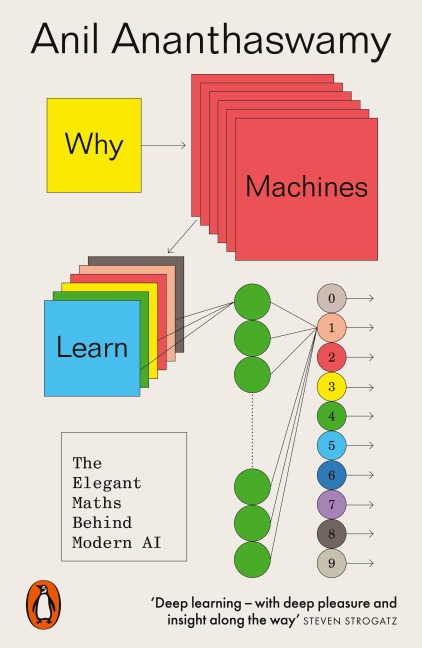
Why Machines Learn: The Elegant Maths Behind Modern AI
-20% with code BOOKS
In stock at our supplier
TOP

The Feynman Lectures on Physics. The New Millennium Edition
Matthew Sands, Robert Leighton, Richard Feynman
-20% with code BOOKS
In stock at our supplier
 TOP
TOP

Entangled Life: How Fungi Make Our Worlds, Change Our Minds and Shape Our Futures
-20% with code BOOKS
In stock at our supplier
TOP

Life As No One Knows It: The Physics of Life's Emergence
-20% with code BOOKS
In stock at our supplier
TOP

The Rise and Reign of the Mammals: A New History, from the Shadow of the Dinosaurs to Us
-20% with code BOOKS
In stock at our supplier
TOP

Learn Faster, Perform Better: A Musician's Guide to the Neuroscience of Practicing
-20% with code BOOKS
In stock at our supplier
TOP

The Road to Reality: A Complete Guide to the Laws of the Universe
-20% with code BOOKS
In stock at our supplier
Description
In 1847, 15 years before Alexander Parkes introduced Parkesine, the great Swedish chemist, Berzelius, reacted tartaric acid with glycerol and formed are sinous mass poly (glyceryl tartrate). Since this was the reaction product o f a polyhydric alcohol and a polybasic acid, it was a polyester resin, although it remained a laboratory curiosity for many years. Polyester resins can claim to be among the first of the many synthetic resins which are now the basis of the plastics industry. The next landmark in the history of polyester resins was the publication by Vorlander in 1894 of the development of the first unsaturated polyester resins, the glycerol maleates. This was followed by the work of W. J. Smith in 1901. He reacted phthalic anhydride with glycerol to produce poly (glyceryl phthalate) and this led to the development of alkyd resins by G.E.C. and B.T.H. from 1913 onwards. By modifying this resin with various vegetable oils an excellent base for paints was produced having outstanding durability and the commercial exploitation of alkyd resins for surface coating took place over the following 20 years.
More Information
| Author | Ravi Bachubhai Patel |
|---|---|
| Publisher | LAP LAMBERT Academic Publishing |
| Release year | 2018 |
| Cover type | Softcover |
| EAN | 9786139940592 |