
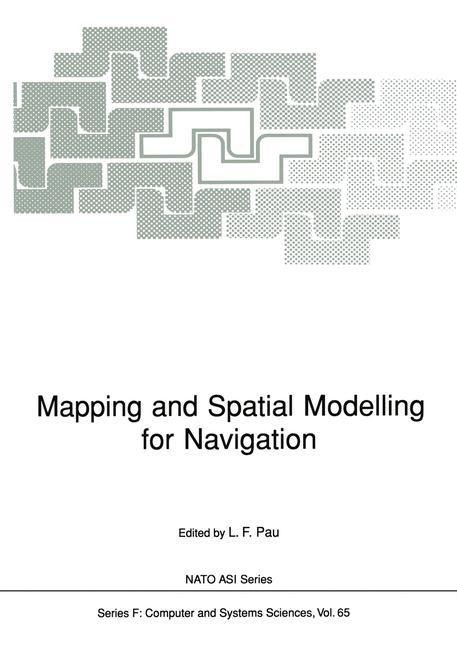
Mapping and Spatial Modelling for Navigation -
-20% with code BOOKS
Shipping in 12-18 days
30-day return policy
The successful implementation of applications in spatial reasoning requires paying attention to the representation of spatial data. In particular, an integrated and uniform treatment of different spatial features is necessary in order to enable the reasoning to proceed quickly. Currently, the most prevalent features are points, rectangles, lines, regions, surfaces, and volumes. As an example of a reasoning ... Full description
You May Also Like

 TOP
TOP

If Anyone Builds It, Everyone Dies: Why Superhuman AI Would Kill Us All
Eliezer Yudkowsky, Nate Soares
-20% with code BOOKS
In stock at our supplier
TOP

Gödel, Escher, Bach: An Eternal Golden Braid
-20% with code BOOKS
In stock at our supplier
TOP
AI Engineering: Building Applications with Foundation Models
-20% with code BOOKS
In stock at our supplier
TOP


The Rust Programming Language
Steve Klabnik, Carol Nichols, Chris Krycho
-20% with code BOOKS
In stock at our supplier
TOP

The Art of Game Design: A Book of Lenses
-20% with code BOOKS
In stock at our supplier
TOP

How To Think About AI: A Guide For The Perplexed
-20% with code BOOKS
In stock at our supplier
TOP

Empire of AI: Dreams and Nightmares in Sam Altman's OpenAI
-20% with code BOOKS
In stock at our supplier
TOP

The Pragmatic Programmer: journey to mastery, 20th Anniversary Edition, 2/e: your journey to mastery, 20th Anniversary Edition
-20% with code BOOKS
In stock at our supplier
TOP

HBR Guide to Generative AI for Managers
-20% with code BOOKS
In stock at our supplier
TOP
Hackers. 25th Anniversary Edition: Heroes of the Computer Revolution
-20% with code BOOKS
In stock at our supplier
TOP

The Web Application Hacker's Handbook: Discovering and Exploiting Security Flaws
-20% with code BOOKS
In stock at our supplier
TOP

How Linux Works: What Every Superuser Should Know
-20% with code BOOKS
In stock at our supplier
TOP
Artificial Intelligence: A Modern Approach, Global Edition
-20% with code BOOKS
In stock at our supplier
TOP
Python Crash Course: A Hands-On, Project-Based Introduction to Programming
-20% with code BOOKS
In stock at our supplier
TOP

Fundamentals of Software Architecture: A Modern Engineering Approach
-20% with code BOOKS
In stock at our supplier
TOP
Speak Data: Artists, Scientists, Thinkers, and Dreamers on How We Live Our Lives in Numbers
-20% with code BOOKS
In stock at our supplier
TOP

Linux Basics for Hackers, 2nd Edition: Getting Started with Networking, Scripting, and Security in Kali
-20% with code BOOKS
In stock at our supplier
TOP
C Programming Language
Brian W. Kernighan, Brian Kernighan, Dennis Ritchie
-20% with code BOOKS
In stock at our supplier
TOP

Proofs from THE BOOK
Martin Aigner, Günter M. Ziegler
-20% with code BOOKS
In stock at our supplier
Description
The successful implementation of applications in spatial reasoning requires paying attention to the representation of spatial data. In particular, an integrated and uniform treatment of different spatial features is necessary in order to enable the reasoning to proceed quickly. Currently, the most prevalent features are points, rectangles, lines, regions, surfaces, and volumes. As an example of a reasoning task consider a query of the form "find all cities with population in excess of 5,000 in wheat growing regions within 10 miles of the Mississippi River. " Note that this query is quite complex. It requires- processing a line map (for the river), creating a corridor or buffer (to find the area within 10 miles of the river), a region map (for the wheat), and a point map (for the cities). Spatial reasoning is eased by spatially sorting the data (i. e. , a spatial index). In this paper we show how hierarchical data structures can be used to facilitate this process. They are based on the principle of recursive decomposition (similar to divide and conquer methods). In essence, they are used primarily as devices to sort data of more than one dimension and different spatial types. The term quadtree is often used to describe this class of data structures. In this paper, we focus on recent developments in the use of quadtree methods. We concentrate primarily on region data. For a more extensive treatment of this subject, see [SameS4a, SameSSa, SameSSb, SameSSc, SameSga, SameSgbj.
More Information
| Publisher | Springer Berlin Heidelberg |
|---|---|
| Series | NATO ASI Subseries F: |
| Release year | 2012 |
| Cover type | Softcover |
| EAN | 9783642842177 |