
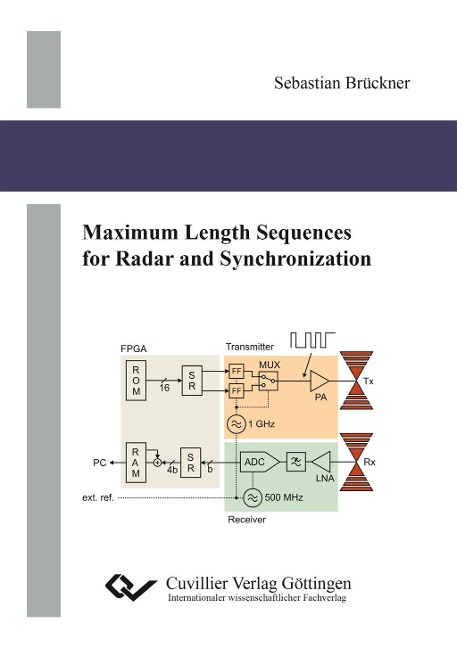
Maximum Length Sequences for Radar and Synchronization - Sebastian Brückner
-20% with code BOOKS
Shipping in 15-21 days
30-day return policy
This dissertation demonstrates the implementation of ultra-wideband (UWB) radar sensors using commercial off-the-shelf electronics. The sensors are based on the correlation of binary pseudo noise sequences (M-sequences), combining low transmit power requirements with excellent noise and interference suppression. A ranging system is introduced that is able to track moving objects with a standard deviation of ... Full description
You May Also Like

 TOP
TOP

INCOSE Systems Engineering Handbook
-20% with code BOOKS
In stock at our supplier
TOP

If Anyone Builds It, Everyone Dies: The Case Against Superintelligent AI
Eliezer Yudkowsky, Nate Soares
-20% with code BOOKS
In stock at our supplier
 TOP
TOP
Open Circuits: The Inner Beauty of Electronic Components
Eric Schlaepfer, Windell Oskay
-20% with code BOOKS
In stock at our supplier
TOP
Get started with MicroPython on Raspberry Pi Pico: The Official Raspberry Pi Pico Guide
-20% with code BOOKS
In stock at our supplier
TOP

Practical Electronics for Inventors
-20% with code BOOKS
In stock at our supplier
TOP

Nucleo Boards Programming with the STM32CubeIDE: Hands-on in more than 50 projects
-20% with code BOOKS
In stock at our supplier
TOP

Data-Driven Science and Engineering: Machine Learning, Dynamical Systems, and Control
Steven L. Brunton, J. Nathan Kutz
-20% with code BOOKS
In stock at our supplier
TOP

Fundamentals of Aerodynamics ISE
Christopher Cadou, John D. Anderson
-20% with code BOOKS
In stock at our supplier
TOP

Black Holes: The Key to Understanding the Universe
-20% with code BOOKS
In stock at our supplier
TOP

KiCad Like A Pro - Fundamentals and Projects: Getting started with the world's best open-source PCB tool
-20% with code BOOKS
In stock at our supplier
TOP

How To Read Water: Clues & Patterns from Puddles to the Sea
-20% with code BOOKS
In stock at our supplier
TOP

Foundations of Flavor: The Noma Guide to Fermentation: Including Step-By-Step Information on Making and Cooking with: Koji, Kombuchas, Shoyus, Misos, Vinegars, Garums, Lacto-Ferments and black Fruits Vegetables
-20% with code BOOKS
In stock at our supplier
TOP
Make: Electronics: Learning by Discovery: A hands-on primer for the new electronics enthusiast
-20% with code BOOKS
In stock at our supplier
TOP

The Idea Factory: Bell Labs and the Great Age of American Innovation
-20% with code BOOKS
In stock at our supplier
TOP

Flowers For Algernon: A Modern Literary Classic
-20% with code BOOKS
In stock at our supplier
 TOP
TOP


Professional SMD Assembly: Practical Low-Cost Methods for Reliable PCB Production
-20% with code BOOKS
In stock at our supplier
TOP

Blood in the Machine: The Origins of the Rebellion Against Big Tech
-20% with code BOOKS
In stock at our supplier
Description
This dissertation demonstrates the implementation of ultra-wideband (UWB) radar sensors using commercial off-the-shelf electronics. The sensors are based on the correlation of binary pseudo noise sequences (M-sequences), combining low transmit power requirements with excellent noise and interference suppression. A ranging system is introduced that is able to track moving objects with a standard deviation of 1.73mm at 2m range. Subsequently, a system is developed which can synchronize itself to a reference sequence with 1.96ps RMS jitter. This synchronization system uses an analog correlating control loop (delay lock loop) to achieve tracking of the reference to 0.38% of one chip. The final application shown is a ground penetrating radar (GPR). The system is comprised of three elements: an FPGA, an output driver for the transmitter and a commercial analog-to-digital converter. Comparative measurements on buried pipes and cables prove that this system has achieved detection capability comparable to commercially available pulsed GPRs.
More Information
| Author | Sebastian Brückner |
|---|---|
| Publisher | Cuvillier |
| Release year | 2016 |
| Cover type | Softcover |
| EAN | 9783736991927 |