
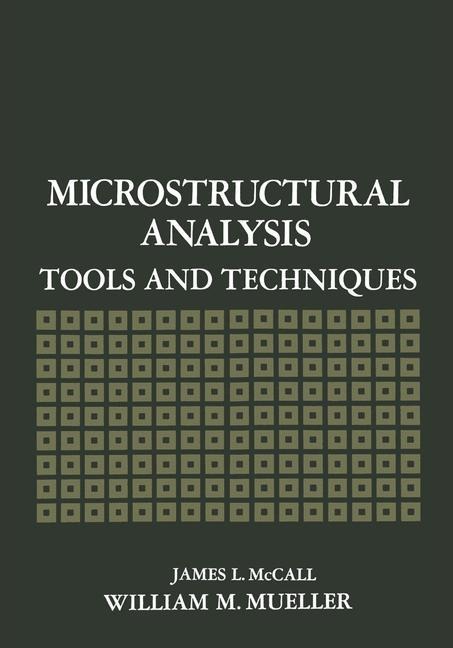
Microstructural Analysis: Tools and Techniques -
-20% with code BOOKS
Shipping in 12-18 days
30-day return policy
During recent years, people involved in developing new metals and materials for use in some of the rather extreme conditions of stress, temperature, and environment have relied heavily on the microstructural condition of their materials. In fact, many of the newer materials, such as dispersion-strengthened alloys, have been designed almost entirely by first determining the microstruc ture desired and then ... Full description
You May Also Like


 TOP
TOP

If Anyone Builds It, Everyone Dies: The Case Against Superintelligent AI
Eliezer Yudkowsky, Nate Soares
-20% with code BOOKS
In stock at our supplier
TOP


We Are Not Machines: The Fight for the Future of Work
-20% with code BOOKS
In stock at our supplier
TOP

Open Circuits: The Inner Beauty of Electronic Components
Eric Schlaepfer, Windell Oskay
-20% with code BOOKS
In stock at our supplier
TOP

Get started with MicroPython on Raspberry Pi Pico: The Official Raspberry Pi Pico Guide
-20% with code BOOKS
In stock at our supplier
TOP

Practical Electronics for Inventors
-20% with code BOOKS
In stock at our supplier
TOP

Nucleo Boards Programming with the STM32CubeIDE: Hands-on in more than 50 projects
-20% with code BOOKS
In stock at our supplier
TOP

INCOSE Systems Engineering Handbook
-20% with code BOOKS
In stock at our supplier
TOP

Fundamentals of Aerodynamics ISE
Christopher Cadou, John D. Anderson
-20% with code BOOKS
In stock at our supplier
TOP

Black Holes: The Key to Understanding the Universe
-20% with code BOOKS
In stock at our supplier
TOP

KiCad Like A Pro - Fundamentals and Projects: Getting started with the world's best open-source PCB tool
-20% with code BOOKS
In stock at our supplier
TOP

Make: Electronics: Learning by Discovery: A hands-on primer for the new electronics enthusiast
-20% with code BOOKS
In stock at our supplier
TOP

Data-Driven Science and Engineering: Machine Learning, Dynamical Systems, and Control
Steven L. Brunton, J. Nathan Kutz
-20% with code BOOKS
In stock at our supplier
TOP

The Idea Factory: Bell Labs and the Great Age of American Innovation
-20% with code BOOKS
In stock at our supplier
TOP

Flowers For Algernon: A Modern Literary Classic
-20% with code BOOKS
In stock at our supplier
TOP

Foundations of Flavor: The Noma Guide to Fermentation: Including Step-By-Step Information on Making and Cooking with: Koji, Kombuchas, Shoyus, Misos, Vinegars, Garums, Lacto-Ferments and black Fruits Vegetables
-20% with code BOOKS
In stock at our supplier
TOP
Professional SMD Assembly: Practical Low-Cost Methods for Reliable PCB Production
-20% with code BOOKS
In stock at our supplier
TOP

Blood in the Machine: The Origins of the Rebellion Against Big Tech
-20% with code BOOKS
In stock at our supplier
TOP

Mastering the Arduino Uno R4: Programming and Projects for the Minima and WiFi
-20% with code BOOKS
In stock at our supplier
Description
During recent years, people involved in developing new metals and materials for use in some of the rather extreme conditions of stress, temperature, and environment have relied heavily on the microstructural condition of their materials. In fact, many of the newer materials, such as dispersion-strengthened alloys, have been designed almost entirely by first determining the microstruc ture desired and then finding the right combination of composition, heat treatment, and mechanical working that will result in the de sired microstructure. Furthermore, the extremely high reliability required of materials used today, for example, in aerospace and nuclear energy systems, requires close control on the microstruc tural conditions of materials. This is clearly evident from even a cursory examination of recently written specifications for mate rials where rather precise microstructural parameters are stipu lated. Whereas specifications written several years ago may have included microstructural requirements for details such as ASTM grain size or graphite type, today's specifications are beginning to include such things as volume fraction of phases, mean free path of particles, and grain intercept distances. Rather arbitrary terms such as "medium pearlite" have been replaced by requirements such as "interlamella spacing not to exceed 0. 1 micron. " Finally, materials users have become increasingly aware that when a material does fail, the reason for its failure may be found by examining and "reading" its microstructure. The responsibility for a particular microstructure and a resulting failure is a matter of growing importance in current product liability consider ations.
More Information
| Publisher | Springer New York |
|---|---|
| Release year | 2012 |
| Cover type | Softcover |
| EAN | 9781461586951 |