
Neuronal Recognition -
-20% with code BOOKS
Shipping in 12-18 days
30-day return policy
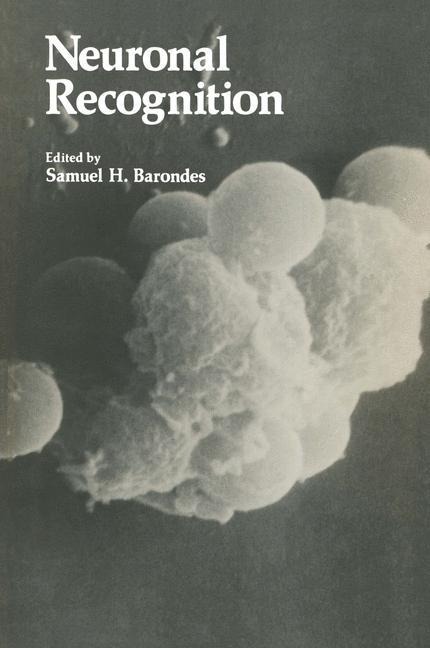
An outstanding characteristic of the nervous system is that neurons make selective functional contacts. Each neuron behaves as if it recog nizes the neurons with which it associates and rejects associations with others. The specific interneuronal relationships that result define the innate neuronal circuits that determine the functioning of this system. The purpose of this volume is to present some approac ... Full description
You May Also Like
 TOP
TOP

The Demon-Haunted World: Science as a Candle in the Dark
-20% with code BOOKS
In stock at our supplier
TOP

The Art of Uncertainty: How to Navigate Chance, Ignorance, Risk and Luck
-20% with code BOOKS
Out of stock
TOP

Heart Rate Variability: Science and Strategies for Peak Performance
Marco Altini, Sylvain Laborde, Dan Plews, Emma Mosley
-20% with code BOOKS
Out of stock
TOP

Many Faces, One Purpose: A Manager's Handbook on Women in Firefighting
U. S. Fire Administration, Homeland Security
-20% with code BOOKS
Out of stock
TOP

The Gulf Moment: Arab Relations Since 2011
Florence Gaub, U. S. Army War College, Strategic Studies Institute
-20% with code BOOKS
Out of stock
 TOP
TOP

Introduction to Algorithms
Ronald L. Rivest, Charles E. Leiserson, Clifford Stein, Thomas H. Cormen
-20% with code BOOKS
In stock at our supplier
TOP

Thinking in Systems: International Bestseller
-20% with code BOOKS
In stock at our supplier
TOP
Skin in the Game: Hidden Asymmetries in Daily Life
-20% with code BOOKS
In stock at our supplier
TOP

101 Things I Learned in Architecture School
-20% with code BOOKS
In stock at our supplier
TOP

Dinosaurs and Prehistoric Life: The Definitive Visual Guide to Prehistoric Animals
-20% with code BOOKS
In stock at our supplier
TOP


Crossing Borders: About the birth of the Consortium of European Research Libraries, the organisation's early years and its path to maturity, spanning the period from the late twentieth century to the first decades of the twenty-first century
-20% with code BOOKS
In stock at our supplier
TOP

The Code Book: The Science of Secrecy from Ancient Egypt to Quantum Cryptography
-20% with code BOOKS
In stock at our supplier
 TOP
TOP

Worth Dying For: The Power and Politics of Flags
-20% with code BOOKS
In stock at our supplier
TOP

Only Dull People Are Brilliant at Breakfast
-20% with code BOOKS
In stock at our supplier
TOP

Playing It by the Book: Printed and Manuscript Book Games in Early Modern Europe
-20% with code BOOKS
In stock at our supplier
TOP

Cybernetics: Second Edition: Or the Control and Communication in the Animal and the Machine
-20% with code BOOKS
In stock at our supplier
TOP

International Economics: Theory and Policy, Global Edition
Paul Krugman, Maurice Obstfeld, Marc Melitz
-20% with code BOOKS
In stock at our supplier
TOP
The Dictionary of Obscure Sorrows
-20% with code BOOKS
In stock at our supplier
Description
An outstanding characteristic of the nervous system is that neurons make selective functional contacts. Each neuron behaves as if it recog nizes the neurons with which it associates and rejects associations with others. The specific interneuronal relationships that result define the innate neuronal circuits that determine the functioning of this system. The purpose of this volume is to present some approaches to the problem of neuronal recognition. The volume has been somewhat arbitrarily divided into three sections. In the first section, the overrid ing theme is the degree of specificity of neuronal recognition. How specific is specific? Is the specificity so precise that the neurites of one neuron will only make synaptic contact with a unique target neuron? If less precise, within what range? Are the rules for specification that are operative in the embryo still operative at the same level of precision when connections regenerate in the mature organism? Are they still operative in dissociated tissue grown in culture? The second section of this volume contains reviews of morphologi cal studies of synaptogenesis and biochemical studies of synaptic com ponents. Can the morphology of developing cellular contacts provide clues about selectivity? Can the chemical components of synaptic junc tions be isolated and characterized? Do they include resolvable compo nents that mediate neuronal recognition? The third section contains studies seeking to identify the existence of specific molecules that might mediate cellular recognition. A major question here is whether molecules of this type even exist.
More Information
| Publisher | Springer New York |
|---|---|
| Series | Current Topics in Neurobiology |
| Release year | 2012 |
| Cover type | Softcover |
| EAN | 9781468422078 |