
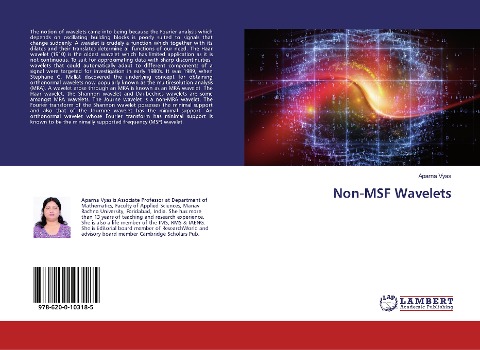
Non-MSF Wavelets - Aparna Vyas
-20% with code BOOKS
Shipping in 15-21 days
30-day return policy
The notion of wavelets came into being because the Fourier analysis which depends on oscillating building blocks is poorly suited to signals that change suddenly. A wavelet is crudely a function which together with its dilates and their translates determine all functions of our need. The Haar wavelet (1910) is the oldest wavelet which has limited application as it is not continuous. To suit for approximatin ... Full description
You May Also Like
 TOP
TOP

Biology: A Global Approach, Global Edition
Neil Campbell, Rebecca Orr, Lisa Urry, Peter Minorsky, Michael Cain, Jane Reece, Steven Wasserman
-20% with code BOOKS
In stock at our supplier
TOP

Six Not-so-easy Pieces: Einstein's Relativity, Symmetry, and Space-Time
Richard P. Feynman, Robert B. Leighton, Matthew Sands
-20% with code BOOKS
In stock at our supplier
TOP

Six Easy Pieces: Essentials of Physics Explained by Its Most Brilliant Teacher
Richard P. Feynman, Robert B. Leighton, Matthew Sands
-20% with code BOOKS
In stock at our supplier
TOP
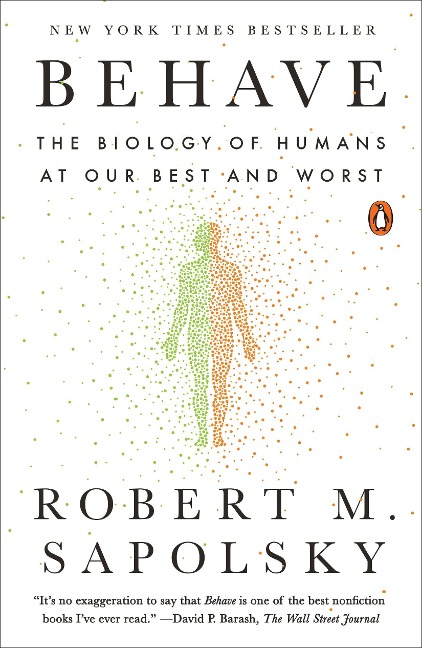
Behave: The Biology of Humans at Our Best and Worst
-20% with code BOOKS
In stock at our supplier
TOP

Determined: The Science of Life Without Free Will
-20% with code BOOKS
In stock at our supplier
 TOP
TOP


The Age of Alchemy: How Early Innovators Shaped Modern Chemistry
-20% with code BOOKS
In stock at our supplier
TOP

The Secrets of our DNA: How Genetics has Changed the World
-20% with code BOOKS
In stock at our supplier
TOP

Janeway's Immunobiology
Leslie J. Berg, Kenneth Murphy, Casey Weaver
-20% with code BOOKS
In stock at our supplier
TOP

Why We Sleep: Unlocking the Power of Sleep and Dreams
-20% with code BOOKS
In stock
TOP

Factfulness: Ten Reasons We're Wrong About the World--and Why Things Are Better Than You Think
Ola Rosling, Anna Rosling Rönnlund, Hans Rosling
-20% with code BOOKS
In stock at our supplier
TOP

The Light Eaters: How the Unseen World of Plant Intelligence Offers a New Understanding of Life on Earth
-20% with code BOOKS
In stock at our supplier
TOP

The Rise and Fall of the Dinosaurs: A New History of a Lost World
-20% with code BOOKS
In stock at our supplier
TOP

The Rise and Reign of the Mammals: A New History, from the Shadow of the Dinosaurs to Us
-20% with code BOOKS
In stock at our supplier
TOP

Learn Faster, Perform Better: A Musician's Guide to the Neuroscience of Practicing
-20% with code BOOKS
In stock at our supplier
TOP
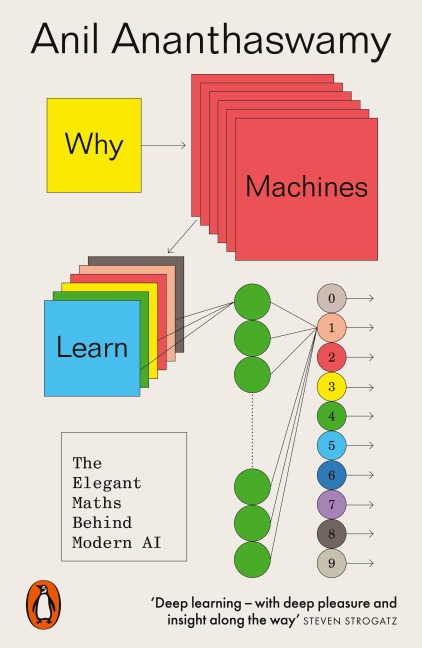
Why Machines Learn: The Elegant Maths Behind Modern AI
-20% with code BOOKS
In stock at our supplier
TOP

Beyond Inheritance: Our Ever-Mutating Cells and a New Understanding of Health
-20% with code BOOKS
In stock at our supplier
 TOP
TOP

The Feynman Lectures on Physics. The New Millennium Edition
Matthew Sands, Robert Leighton, Richard Feynman
-20% with code BOOKS
In stock at our supplier
TOP

How to Solve it: A New Aspect of Mathematical Method
-20% with code BOOKS
In stock at our supplier
Description
The notion of wavelets came into being because the Fourier analysis which depends on oscillating building blocks is poorly suited to signals that change suddenly. A wavelet is crudely a function which together with its dilates and their translates determine all functions of our need. The Haar wavelet (1910) is the oldest wavelet which has limited application as it is not continuous. To suit for approximating data with sharp discontinuities, wavelets that could automatically adapt to different components of a signal were targeted for investigation in early 1980's. It was 1989, when Stephane G. Mallat discovered the underlying concept for obtaining orthonormal wavelets now popularly known as the multiresolution analysis (MRA). A wavelet arose through an MRA is known as an MRA wavelet. The Haar wavelet, the Shannon wavelet and Daubechies wavelets are some amongst MRA wavelets. The Journe wavelet is a non-MRA wavelet. The Fourier transform of the Shannon wavelet possesses the minimal support and also that of the Journne wavelet has the minimal support. An orthonormal wavelet whose Fourier transform has minimal support is known to be the minimally supported frequency (MSF) wavelet.
More Information
| Author | Aparna Vyas |
|---|---|
| Publisher | LAP LAMBERT Academic Publishing |
| Release year | 2019 |
| Cover type | Softcover |
| EAN | 9786200103185 |