
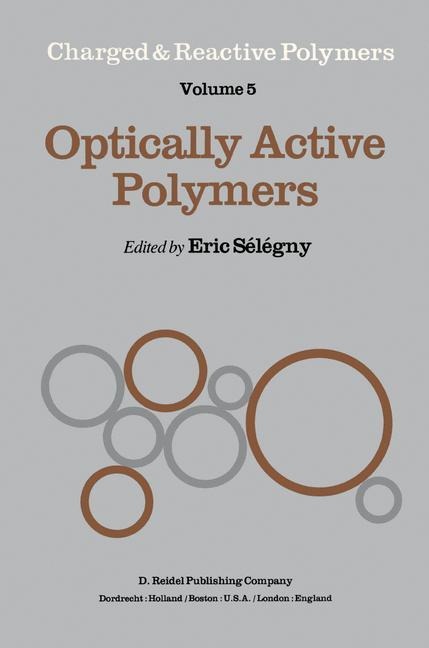
Optically Active Polymers -
-20% with code BOOKS
Shipping in 17-23 days
30-day return policy
The first four volumes of the series on 'Charged and Reactive Polymers' have been devoted to polymers in solution (Voh. I and II) or in gel and membrane forms (Vols. III and IV). In correlation with charges, other physical or chemical properties of macro molecules have been considered. Understanding of charge and hydrophobic effects is equally important for synthetic and biopolymers or their systems. Optic ... Full description
You May Also Like
 TOP
TOP

Six Not-so-easy Pieces: Einstein's Relativity, Symmetry, and Space-Time
Richard P. Feynman, Robert B. Leighton, Matthew Sands
-20% with code BOOKS
In stock at our supplier
TOP

Six Easy Pieces: Essentials of Physics Explained by Its Most Brilliant Teacher
Richard P. Feynman, Robert B. Leighton, Matthew Sands
-20% with code BOOKS
In stock at our supplier
TOP
Behave: The Biology of Humans at Our Best and Worst
-20% with code BOOKS
In stock at our supplier
TOP

Determined: The Science of Life Without Free Will
-20% with code BOOKS
In stock at our supplier
 TOP
TOP

The Age of Alchemy: How Early Innovators Shaped Modern Chemistry
-20% with code BOOKS
In stock at our supplier
TOP

The Secrets of our DNA: How Genetics has Changed the World
-20% with code BOOKS
In stock at our supplier
TOP
Why We Sleep: Unlocking the Power of Sleep and Dreams
-20% with code BOOKS
In stock
TOP

Biology: A Global Approach, Global Edition
Neil Campbell, Rebecca Orr, Lisa Urry, Peter Minorsky, Michael Cain, Jane Reece, Steven Wasserman
-20% with code BOOKS
In stock at our supplier
TOP
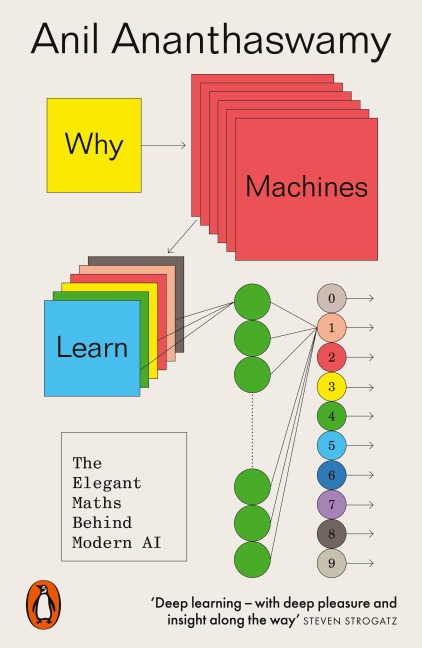
Why Machines Learn: The Elegant Maths Behind Modern AI
-20% with code BOOKS
In stock at our supplier
TOP

A Short History of Nearly Everything 2.0
-20% with code BOOKS
In stock at our supplier
TOP

Astrophysics for People in a Hurry: Essays on the Universe and Our Place Within It
-20% with code BOOKS
In stock at our supplier
TOP

The Rise and Fall of the Dinosaurs: A New History of a Lost World
-20% with code BOOKS
In stock at our supplier
TOP

The Rise and Reign of the Mammals: A New History, from the Shadow of the Dinosaurs to Us
-20% with code BOOKS
In stock at our supplier
TOP

Learn Faster, Perform Better: A Musician's Guide to the Neuroscience of Practicing
-20% with code BOOKS
In stock at our supplier
TOP

Beyond Inheritance: Our Ever-Mutating Cells and a New Understanding of Health
-20% with code BOOKS
In stock at our supplier
TOP

A Brief History of Time: From the Big Bang to Black Holes
-20% with code BOOKS
In stock at our supplier
 TOP
TOP

Thing Explainer: Complicated Stuff in Simple Words
-20% with code BOOKS
In stock at our supplier
TOP

Introduction to Quantum Mechanics
Darrell F. Schroeter, David J. Griffiths
-20% with code BOOKS
In stock at our supplier
Description
The first four volumes of the series on 'Charged and Reactive Polymers' have been devoted to polymers in solution (Voh. I and II) or in gel and membrane forms (Vols. III and IV). In correlation with charges, other physical or chemical properties of macro molecules have been considered. Understanding of charge and hydrophobic effects is equally important for synthetic and biopolymers or their systems. Optically Active Polymers are related to problems of the same class, since optical activity is an inherent property of both natural macromolecules as well as a great variety of polymers synthesized in the Jast twenty years. Optical activity is a physical spectral property of chiral matter caused by asymmetrical configurations, conformations and structures which have no plane and no center of symmetry and consequently have two mirror image enantiomeric forms of inverse optical rotation. The racemic mixture of chiral enantiomers is optically inactive. The most common form of optical activity was first measured at a constant wavelength by the angle of rotation of linearly polarized light. More recently the measurements have been extended to the entire range of visible and attainable ultraviolet regions where electronic transitions are observed, giving rise to the ORD technique (Optical Rotatory Dispersion). The Cotton effects appear in the region of optically active absorption bands; outside of these bands the plain curve spectrum is also dependent on all the electronic transitions of the chromophores.
More Information
| Publisher | Springer Netherlands |
|---|---|
| Series | Charged and Reactive Polymers |
| Release year | 1979 |
| Cover type | Hardcover |
| EAN | 9789027709042 |