
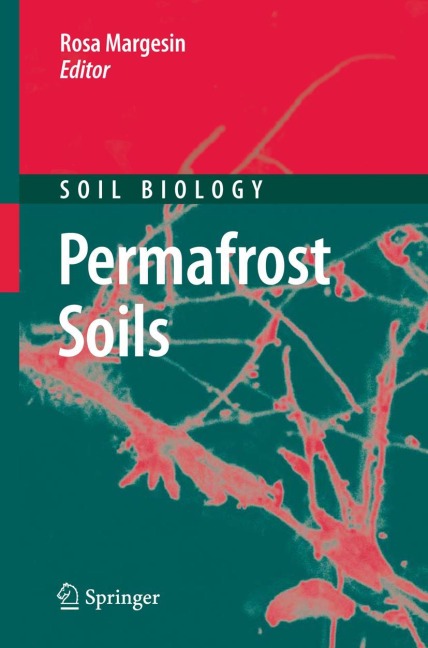
Permafrost Soils -
-20% with code BOOKS
Shipping in 12-18 days
30-day return policy
Most of the Earth¿s biosphere is characterized by low temperatures. Vast areas (>20%) of the soil ecosystem are permanently frozen or are unfrozen for only a few weeks in summer. Permafrost regions occur at high latitudes and also at high ele- tions; a significant part of the global permafrost area is represented by mountains. Permafrost soils are of global interest, since a significant increase in tempe ... Full description
You May Also Like
 TOP
TOP

Determined: The Science of Life Without Free Will
-20% with code BOOKS
In stock at our supplier
TOP
The Rise and Fall of the Dinosaurs: A New History of a Lost World
-20% with code BOOKS
In stock at our supplier
TOP

Factfulness: Ten Reasons We're Wrong About the World--and Why Things Are Better Than You Think
Ola Rosling, Anna Rosling Rönnlund, Hans Rosling
-20% with code BOOKS
In stock at our supplier
TOP
Biology: A Global Approach, Global Edition
Neil Campbell, Rebecca Orr, Lisa Urry, Peter Minorsky, Michael Cain, Jane Reece, Steven Wasserman
-20% with code BOOKS
In stock at our supplier
TOP

Six Not-so-easy Pieces: Einstein's Relativity, Symmetry, and Space-Time
Richard P. Feynman, Robert B. Leighton, Matthew Sands
-20% with code BOOKS
In stock at our supplier
TOP

Entangled Life: How Fungi Make Our Worlds, Change Our Minds and Shape Our Futures
-20% with code BOOKS
In stock at our supplier
TOP

The Light Eaters: How the Unseen World of Plant Intelligence Offers a New Understanding of Life on Earth
-20% with code BOOKS
In stock at our supplier
 TOP
TOP


The Age of Alchemy: How Early Innovators Shaped Modern Chemistry
-20% with code BOOKS
In stock at our supplier
TOP

The Secrets of our DNA: How Genetics has Changed the World
-20% with code BOOKS
In stock at our supplier
TOP

Janeway's Immunobiology
Leslie J. Berg, Kenneth Murphy, Casey Weaver
-20% with code BOOKS
In stock at our supplier
TOP

How to Solve it: A New Aspect of Mathematical Method
-20% with code BOOKS
In stock at our supplier
TOP

Behave: The Biology of Humans at Our Best and Worst
-20% with code BOOKS
In stock at our supplier
TOP

Why We Sleep: Unlocking the Power of Sleep and Dreams
-20% with code BOOKS
In stock
TOP

Why Machines Learn: The Elegant Maths Behind Modern AI
-20% with code BOOKS
In stock at our supplier
TOP

Six Easy Pieces: Essentials of Physics Explained by Its Most Brilliant Teacher
Richard P. Feynman, Robert B. Leighton, Matthew Sands
-20% with code BOOKS
In stock at our supplier
TOP
The Rise and Reign of the Mammals: A New History, from the Shadow of the Dinosaurs to Us
-20% with code BOOKS
In stock at our supplier
TOP

Learn Faster, Perform Better: A Musician's Guide to the Neuroscience of Practicing
-20% with code BOOKS
In stock at our supplier
TOP

The Brain That Changes Itself: Stories of Personal Triumph from the Frontiers of Brain Science
-20% with code BOOKS
In stock at our supplier
Description
Most of the Earth¿s biosphere is characterized by low temperatures. Vast areas (>20%) of the soil ecosystem are permanently frozen or are unfrozen for only a few weeks in summer. Permafrost regions occur at high latitudes and also at high ele- tions; a significant part of the global permafrost area is represented by mountains. Permafrost soils are of global interest, since a significant increase in temperature is predicted for polar regions. Global warming will have a great impact on these soils, especially in northern regions, since they contain large amounts of organic carbon and act as carbon sinks, and a temperature increase will result in a release of carbon into the atmosphere. Additionally, the intensified release of the clima- relevant tracer gas methane represents a potential environmental harzard. Significant numbers of viable microorganisms, including bacteria, archaea, p- totrophic cyanobacteria and green algae, fungi and protozoa, are present in per- frost, and the characteristics of these microorganisms reflect the unique and extreme conditions of the permafrost environment. Remarkably, these microorg- isms have been reported to be metabolically active at subzero temperatures, even down to ?20°C.
More Information
| Publisher | Springer Berlin Heidelberg |
|---|---|
| Series | Soil Biology |
| Release year | 2010 |
| Cover type | Softcover |
| EAN | 9783642088872 |