
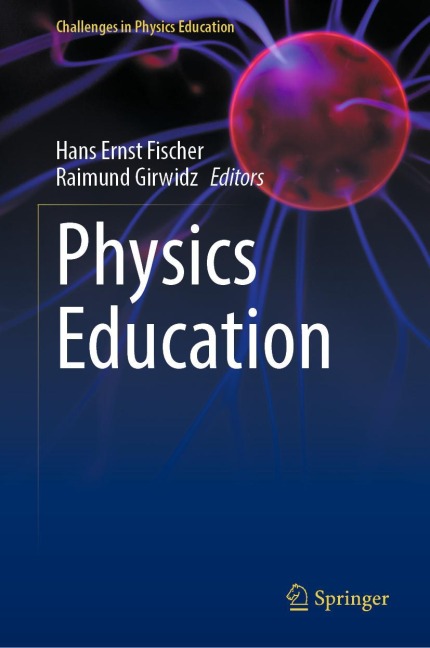
Physics Education -
-20% with code BOOKS
Shipping in 17-23 days
30-day return policy
This book offers a comprehensive overview of the theoretical background and practice of physics teaching and learning and assists in the integration of highly interesting topics into physics lessons. Researchers in the field, including experienced educators, discuss basic theories, the methods and some contents of physics teaching and learning, highlighting new and traditional perspectives on physics instru ... Full description
You May Also Like
 TOP
TOP

The Culture Map: Breaking Through the Invisible Boundaries of Global Business
-20% with code BOOKS
In stock
TOP

Atomic Habits: An Easy & Proven Way to Build Good Habits & Break Bad Ones
-20% with code BOOKS
In stock
TOP

The Nord Stream Conspiracy: The Inside Story of the Explosions That Shook the World
-20% with code BOOKS
Out of stock
 TOP
TOP

Prisoners of Geography: Updated 10th Anniversary Edition: Ten Maps That Tell You Everything You Need To Know About Global Politics
-20% with code BOOKS
In stock at our supplier
TOP

Women Who Run with the Wolves: Myths and Stories of the Wild Woman Archetype
Clarissa Pinkola Estés, Clarissa Pinkola Estes
-20% with code BOOKS
In stock at our supplier
TOP
Sapiens: A Brief History of Humankind
-20% with code BOOKS
In stock at our supplier
TOP

How Democracies Die
Steven Levitsky, Daniel Ziblatt
-20% with code BOOKS
In stock at our supplier
TOP


Classic Football Shirts
Classic Football Shirts, Rory Smith
-20% with code BOOKS
In stock at our supplier
 TOP
TOP

The Whole-Brain Child: 12 Revolutionary Strategies to Nurture Your Child's Developing Mind
Daniel J. Siegel, Tina Payne Bryson
-20% with code BOOKS
In stock at our supplier
 TOP
TOP

Everything I Know About Love: Now a Major BBC One Series
-20% with code BOOKS
In stock
TOP

Braiding Sweetgrass: Indigenous Wisdom, Scientific Knowledge and the Teachings of Plants
-20% with code BOOKS
In stock at our supplier
TOP

The Unabridged Journals of Sylvia Plath
-20% with code BOOKS
In stock at our supplier
 TOP
TOP

To Kill a Mockingbird. 60th Anniversary Edition
-20% with code BOOKS
In stock at our supplier
TOP

Caliban and the Witch: Women, the Body and Primitive Accumulation
-20% with code BOOKS
In stock at our supplier
TOP

Monsters: What Do We Do with Great Art by Bad People?
-20% with code BOOKS
In stock at our supplier
TOP

Breaking Through: My Life in Science
-20% with code BOOKS
In stock at our supplier
Description
This book offers a comprehensive overview of the theoretical background and practice of physics teaching and learning and assists in the integration of highly interesting topics into physics lessons. Researchers in the field, including experienced educators, discuss basic theories, the methods and some contents of physics teaching and learning, highlighting new and traditional perspectives on physics instruction. A major aim is to explain how physics can be taught and learned effectively and in a manner enjoyable for both the teacher and the student. Close attention is paid to aspects such as teacher competences and requirements, lesson structure, and the use of experiments in physics lessons. The roles of mathematical and physical modeling, multiple representations, instructional explanations, and digital media in physics teaching are all examined. Quantitative and qualitative research on science education in schools is discussed, as quality assessment of physics instruction. The book is of great value to researchers involved in the teaching and learning of physics, to those training physics teachers, and to pre-service and practising physics teachers.
More Information
| Publisher | Springer Nature Switzerland |
|---|---|
| Series | Challenges in Physics Education |
| Release year | 2022 |
| Cover type | Hardcover |
| EAN | 9783030873905 |