
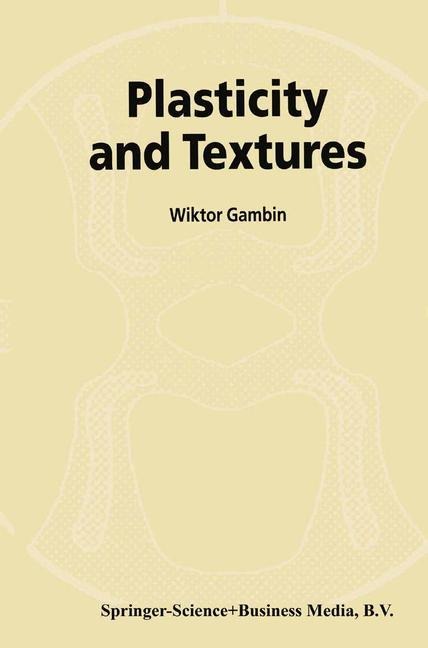
Plasticity and Textures - W. Gambin
-20% with code BOOKS
Shipping in 17-23 days
30-day return policy
The classical, phenomenological theory of plastically anisotropic materials has passed a long way: from the work of von Mises presented in 1928, and the HilI formulation given in 1948, to the latest papers on large elastic-plastic deformations of anisotropic metal sheets. A characteristic feature of this approach is a linear flow rule and a quadratic yield criterion. Mathematical simplicity of the theory is ... Full description
You May Also Like

 TOP
TOP

INCOSE Systems Engineering Handbook
-20% with code BOOKS
In stock at our supplier
TOP
If Anyone Builds It, Everyone Dies: The Case Against Superintelligent AI
Eliezer Yudkowsky, Nate Soares
-20% with code BOOKS
In stock at our supplier
 TOP
TOP
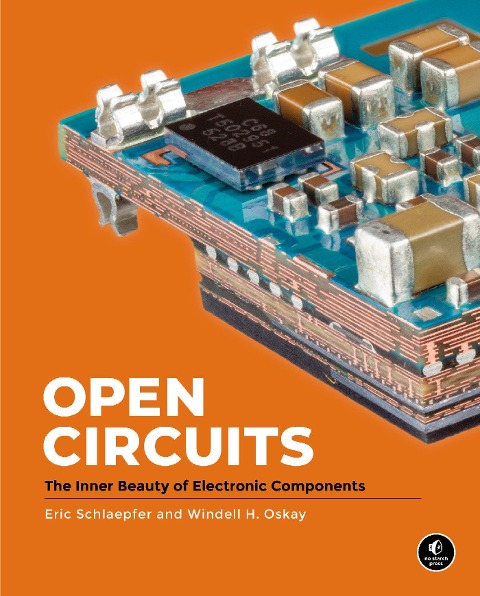
Open Circuits: The Inner Beauty of Electronic Components
Eric Schlaepfer, Windell Oskay
-20% with code BOOKS
In stock at our supplier
TOP

Get started with MicroPython on Raspberry Pi Pico: The Official Raspberry Pi Pico Guide
-20% with code BOOKS
In stock at our supplier
TOP

Practical Electronics for Inventors
-20% with code BOOKS
In stock at our supplier
TOP

Nucleo Boards Programming with the STM32CubeIDE: Hands-on in more than 50 projects
-20% with code BOOKS
In stock at our supplier
TOP
Data-Driven Science and Engineering: Machine Learning, Dynamical Systems, and Control
Steven L. Brunton, J. Nathan Kutz
-20% with code BOOKS
In stock at our supplier
TOP

Fundamentals of Aerodynamics ISE
Christopher Cadou, John D. Anderson
-20% with code BOOKS
In stock at our supplier
TOP

Black Holes: The Key to Understanding the Universe
-20% with code BOOKS
In stock at our supplier
TOP

KiCad Like A Pro - Fundamentals and Projects: Getting started with the world's best open-source PCB tool
-20% with code BOOKS
In stock at our supplier
TOP

How To Read Water: Clues & Patterns from Puddles to the Sea
-20% with code BOOKS
In stock at our supplier
TOP

Foundations of Flavor: The Noma Guide to Fermentation: Including Step-By-Step Information on Making and Cooking with: Koji, Kombuchas, Shoyus, Misos, Vinegars, Garums, Lacto-Ferments and black Fruits Vegetables
-20% with code BOOKS
In stock at our supplier
TOP
Make: Electronics: Learning by Discovery: A hands-on primer for the new electronics enthusiast
-20% with code BOOKS
In stock at our supplier
TOP

The Idea Factory: Bell Labs and the Great Age of American Innovation
-20% with code BOOKS
In stock at our supplier
TOP

Flowers For Algernon: A Modern Literary Classic
-20% with code BOOKS
In stock at our supplier
 TOP
TOP


Professional SMD Assembly: Practical Low-Cost Methods for Reliable PCB Production
-20% with code BOOKS
In stock at our supplier
TOP

Blood in the Machine: The Origins of the Rebellion Against Big Tech
-20% with code BOOKS
In stock at our supplier
Description
The classical, phenomenological theory of plastically anisotropic materials has passed a long way: from the work of von Mises presented in 1928, and the HilI formulation given in 1948, to the latest papers on large elastic-plastic deformations of anisotropic metal sheets. A characteristic feature of this approach is a linear flow rule and a quadratic yield criterion. Mathematical simplicity of the theory is a reason of its numerous applications to the analysis of engineering structures during the onset of plastic deformations. However, such an approach is not sufficient for description of the metal forming processes, when a metal element undergoes very large plastic strains. If we take an initially isotropic piece of metal, it becomes plastically anisotropic during the forming process, and the induced anisotropy progressively increases. This fact strongly determines directions of plastic flow, and it leads to an unexpected strain localization in sheet elements. To explain the above, it is necessary to take into account a polycrystalline structure of the metal, plastic slips on slip systems of grains, crystallographic lattice rotations, and at last, a formation of textures and their evolution during the whole deformation process. In short, it is necessary to introduce the plasticity of crystals and polycrystals. The polycrystal analysis shows that, when the advanced plastic strains take place, some privileged crystallographic directions, called a crystallographic texture, occur in the material. The texture formation and evolution are a primary reason for the induced plastic anisotropy in pure metals.
More Information
| Author | W. Gambin |
|---|---|
| Publisher | Springer Netherlands |
| Release year | 2001 |
| Cover type | Hardcover |
| EAN | 9781402002120 |