
Polymerisation and Depolymerisation: Faraday Discussion 262 -

-20% with code BOOKS
Shipping in 31-37 days
30-day return policy
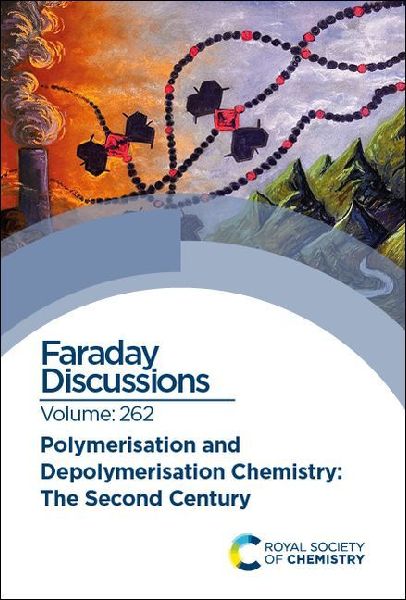
This Faraday Discussion focuses on the scientific questions, challenges and areas for future development to advance polymer science. It comprises the following interrelated themes: utilisation of novel feedstocks and reduction in greenhouse gas emissions in making polymers methods to control monomer sequence and polymer architectures for function and application polymerisation processes, including data-driv ... Full description
You May Also Like
 TOP
TOP

Six Not-so-easy Pieces: Einstein's Relativity, Symmetry, and Space-Time
Richard P. Feynman, Robert B. Leighton, Matthew Sands
-20% with code BOOKS
In stock at our supplier
TOP

Six Easy Pieces: Essentials of Physics Explained by Its Most Brilliant Teacher
Richard P. Feynman, Robert B. Leighton, Matthew Sands
-20% with code BOOKS
In stock at our supplier
TOP

Behave: The Biology of Humans at Our Best and Worst
-20% with code BOOKS
In stock at our supplier
TOP

Determined: The Science of Life Without Free Will
-20% with code BOOKS
In stock at our supplier
 TOP
TOP

Beyond Inheritance: Our Ever-Mutating Cells and a New Understanding of Health
-20% with code BOOKS
In stock at our supplier
TOP

The Age of Alchemy: How Early Innovators Shaped Modern Chemistry
-20% with code BOOKS
In stock at our supplier
TOP
The Secrets of our DNA: How Genetics has Changed the World
-20% with code BOOKS
In stock at our supplier
TOP
Introduction to Quantum Mechanics
Darrell F. Schroeter, David J. Griffiths
-20% with code BOOKS
In stock at our supplier
TOP
Why We Sleep: Unlocking the Power of Sleep and Dreams
-20% with code BOOKS
In stock
TOP
Biology: A Global Approach, Global Edition
Neil Campbell, Rebecca Orr, Lisa Urry, Peter Minorsky, Michael Cain, Jane Reece, Steven Wasserman
-20% with code BOOKS
In stock at our supplier
TOP
Why Machines Learn: The Elegant Maths Behind Modern AI
-20% with code BOOKS
In stock at our supplier
TOP
A Short History of Nearly Everything 2.0
-20% with code BOOKS
In stock at our supplier
TOP

Astrophysics for People in a Hurry: Essays on the Universe and Our Place Within It
-20% with code BOOKS
In stock at our supplier
TOP
The Rise and Fall of the Dinosaurs: A New History of a Lost World
-20% with code BOOKS
In stock at our supplier
TOP
The Rise and Reign of the Mammals: A New History, from the Shadow of the Dinosaurs to Us
-20% with code BOOKS
In stock at our supplier
TOP

Learn Faster, Perform Better: A Musician's Guide to the Neuroscience of Practicing
-20% with code BOOKS
In stock at our supplier
TOP

A Brief History of Time: From the Big Bang to Black Holes
-20% with code BOOKS
In stock at our supplier
 TOP
TOP

Thing Explainer: Complicated Stuff in Simple Words
-20% with code BOOKS
In stock at our supplier
Description
This Faraday Discussion focuses on the scientific questions, challenges and areas for future development to advance polymer science. It comprises the following interrelated themes:
- utilisation of novel feedstocks and reduction in greenhouse gas emissions in making polymers
- methods to control monomer sequence and polymer architectures for function and application
- polymerisation processes, including data-driven design and manufacturing processes
- recycling and depolymerisation methods, including biodegradation, to improve circularity
Novel feedstocks
This section focuses on the chemistry and processes to make monomers and to functionalise natural biopolymers. It includes papers on the use and benefits for biomass derived monomers, such as those from carbohydrates, triglycerides, lignin and terpenes, with a particular focus on use of co-products and wastes in polymer production.
Catalysis
This section investigates how catalysis can be used to make polymerisation processes more efficient and more sustainable, and to control polymer sequences, stereo- and regiochemistry, so as to enable innovative material and properties. Discussion topics include organocatalysis, metal-based catalysis and heterogeneous catalysis, the synthesis of novel catalytic systems, the elucidation of catalytic reactions using experimental and computational methods (including in situ reaction monitoring), and the impact of residual catalytic species on polymer properties.
Polymerisation processes and computational methods to control structure
This section discusses how to regulate, control and effect control over polymer sequences, structures, architectures and molar mass distributions by using external stimuli and process control. The section also covers how data and machine learning-driven approaches can help to improve polymerisation processes. The types of chemistry discussed include 'triggers/switches and stimuli', methods to control molar mass distributions, polymer syntheses in flow, and computational approaches to optimise structures and performances.
Closing the loop - the chemistry of depolymerisation, polymer recycling and environmental degradation
This section examines the chemistry and fundamental science challenges associated with the different end-life options for polymers. Discussion topics include chemical recycling, designing polymer structures for efficient mechanical recycling, polymer upcycling and re-purposing, depolymerisation kinetics/thermodynamics and mechanisms, depolymerisation catalysis, polymer composting and biodegradation. The environmental chemistry of polymers is also discussed. Future opportunities to combine effective polymerisation and depolymerisation strategies into the design of polymer structures are at the heart of this section and the associated discussions.
More Information
| Publisher | RSC Publishing |
|---|---|
| Release year | 2026 |
| Cover type | Hardcover |
| EAN | 9781837070688 |