
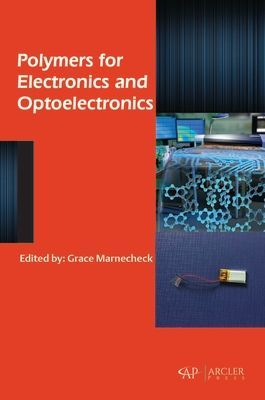
Polymers for Electronics and Optoelectronics -
-20% with code BOOKS
Shipping in 31-37 days
30-day return policy
Natural polymers, such as rubber, cotton, and wood, have been used for a long time. Other biologically important natural polymes such as proteins, enzymes, and cellulose are involved in different physiological processes in animals and plants (Rethwisch & Callister, 2011). Current scientific research has discovered the molecular structures of these natural polymers, which consequently have resulted in th ... Full description
You May Also Like

 TOP
TOP

INCOSE Systems Engineering Handbook
-20% with code BOOKS
In stock at our supplier
TOP

If Anyone Builds It, Everyone Dies: The Case Against Superintelligent AI
Eliezer Yudkowsky, Nate Soares
-20% with code BOOKS
In stock at our supplier
 TOP
TOP
Open Circuits: The Inner Beauty of Electronic Components
Eric Schlaepfer, Windell Oskay
-20% with code BOOKS
In stock at our supplier
TOP
Get started with MicroPython on Raspberry Pi Pico: The Official Raspberry Pi Pico Guide
-20% with code BOOKS
In stock at our supplier
TOP
Practical Electronics for Inventors
-20% with code BOOKS
In stock at our supplier
TOP

Nucleo Boards Programming with the STM32CubeIDE: Hands-on in more than 50 projects
-20% with code BOOKS
In stock at our supplier
TOP

Fundamentals of Aerodynamics ISE
Christopher Cadou, John D. Anderson
-20% with code BOOKS
In stock at our supplier
TOP

Black Holes: The Key to Understanding the Universe
-20% with code BOOKS
In stock at our supplier
TOP

How To Read Water: Clues & Patterns from Puddles to the Sea
-20% with code BOOKS
In stock at our supplier
TOP

Foundations of Flavor: The Noma Guide to Fermentation: Including Step-By-Step Information on Making and Cooking with: Koji, Kombuchas, Shoyus, Misos, Vinegars, Garums, Lacto-Ferments and black Fruits Vegetables
-20% with code BOOKS
In stock at our supplier
TOP
Make: Electronics: Learning by Discovery: A hands-on primer for the new electronics enthusiast
-20% with code BOOKS
In stock at our supplier
TOP

Data-Driven Science and Engineering: Machine Learning, Dynamical Systems, and Control
Steven L. Brunton, J. Nathan Kutz
-20% with code BOOKS
In stock at our supplier
TOP

The Idea Factory: Bell Labs and the Great Age of American Innovation
-20% with code BOOKS
In stock at our supplier
TOP

Flowers For Algernon: A Modern Literary Classic
-20% with code BOOKS
In stock at our supplier
 TOP
TOP

Professional SMD Assembly: Practical Low-Cost Methods for Reliable PCB Production
-20% with code BOOKS
In stock at our supplier
TOP

Blood in the Machine: The Origins of the Rebellion Against Big Tech
-20% with code BOOKS
In stock at our supplier
TOP

KiCad Like A Pro - Fundamentals and Projects: Getting started with the world's best open-source PCB tool
-20% with code BOOKS
In stock at our supplier
Description
Natural polymers, such as rubber, cotton, and wood, have been used for a long time. Other biologically important natural polymes such as proteins, enzymes, and cellulose are involved in different physiological processes in animals and plants (Rethwisch & Callister, 2011). Current scientific research has discovered the molecular structures of these natural polymers, which consequently have resulted in the development of many synthetic polymers. World War II witnessed the polymer's first major application: aircraft windows were first replaced by polymers instead of traditional glass. Bubble canopies for gun turrets were also produced from polymeric material (Ali, Khairil Juhanni Bt, & Nor Aziah, 2015).After World War II, great effort was exerted by scientists and manufacturers to replace metals with polymers in many fields due to enhancements of physical, mechanical, thermal and electrical properties of polymers. Nowadays, polymers are important alternatives for designers in all fields.In 1977, polymers entered a new era of usage and applications when conductivity of polyacetylene was first discovered. Following that discovery, numerous research studies and papers were published on the conductivity of polymers. Polymers became a strong competitor to traditional conductor and semi-conductor metals used in electrical and electronics applications due to their price, low density, formability and availability (Margolis J. M., 1989).As a result of these research studies and efforts exerted by manufacturers, polymers are now used in producing diodes, transistors, printed circuit boards and other important electronics and optoelectronics applications.This book consists of two parts: the first part is a general overview on polymer structure, properties and formation. The second part will discuss special types of polymers used for electronics and optoelectronics applications.
More Information
| Publisher | Arcler Press |
|---|---|
| Release year | 2017 |
| Cover type | Hardcover |
| EAN | 9781773612386 |