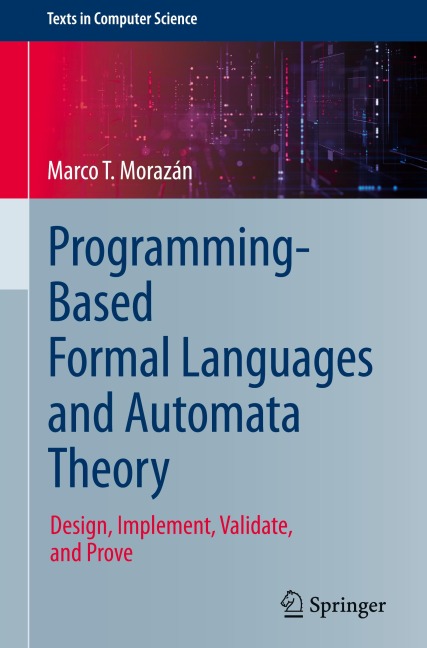
Programming-Based Formal Languages and Automata Theory: Design, Implement, Validate, and Prove - Marco T. Morazán
-30% with code BOOKS
Shipping in 17-23 days
30-day return policy
This textbook introduces formal languages and automata theory for upper-level undergraduate or beginning graduate students. While it contains the traditional mathematical development usually employed in computational theory courses, it is also quite different from many of them. Machines, grammars, and algorithms developed as part of a constructive proof are intended to be rendered as programs. The book is d ... Full description
You May Also Like
 TOP
TOP

If Anyone Builds It, Everyone Dies: Why Superhuman AI Would Kill Us All
Eliezer Yudkowsky, Nate Soares
-30% with code BOOKS
In stock at our supplier
 TOP
TOP
How To Think About AI: A Guide For The Perplexed
-30% with code BOOKS
In stock at our supplier
TOP

Gödel, Escher, Bach: An Eternal Golden Braid
-30% with code BOOKS
In stock at our supplier
TOP
AI Engineering: Building Applications with Foundation Models
-30% with code BOOKS
In stock at our supplier
TOP
Empire of AI: Dreams and Nightmares in Sam Altman's OpenAI
-30% with code BOOKS
In stock at our supplier
TOP
Python Crash Course: A Hands-On, Project-Based Introduction to Programming
-30% with code BOOKS
In stock at our supplier
TOP


The Rust Programming Language
Steve Klabnik, Carol Nichols, Chris Krycho
-30% with code BOOKS
In stock at our supplier
TOP

How to Talk to AI: (And How Not To)
-30% with code BOOKS
In stock at our supplier
TOP
The Pragmatic Programmer: journey to mastery, 20th Anniversary Edition, 2/e: your journey to mastery, 20th Anniversary Edition
-30% with code BOOKS
In stock at our supplier
TOP
Hackers. 25th Anniversary Edition: Heroes of the Computer Revolution
-30% with code BOOKS
In stock at our supplier
TOP
The Art of Game Design: A Book of Lenses
-30% with code BOOKS
In stock at our supplier
TOP

How Linux Works: What Every Superuser Should Know
-30% with code BOOKS
In stock at our supplier
TOP
Hands-On Large Language Models: Language Understanding and Generation
Maarten Grootendorst, Jay Alammar
-30% with code BOOKS
In stock at our supplier
TOP
Fundamentals of Software Architecture: A Modern Engineering Approach
-30% with code BOOKS
In stock at our supplier
TOP
Speak Data: Artists, Scientists, Thinkers, and Dreamers on How We Live Our Lives in Numbers
-30% with code BOOKS
In stock at our supplier
TOP
Clean Architecture: A Craftsman's Guide to Software Structure and Design
-30% with code BOOKS
In stock at our supplier
TOP
World of Warcraft Chronicle, Volume 2
-30% with code BOOKS
In stock at our supplier
TOP
Linux Basics for Hackers, 2nd Edition: Getting Started with Networking, Scripting, and Security in Kali
-30% with code BOOKS
In stock at our supplier
TOP
Deep Learning: Foundations and Concepts
Christopher M. Bishop, Hugh Bishop
-30% with code BOOKS
In stock at our supplier
Description
This textbook introduces formal languages and automata theory for upper-level undergraduate or beginning graduate students. While it contains the traditional mathematical development usually employed in computational theory courses, it is also quite different from many of them. Machines, grammars, and algorithms developed as part of a constructive proof are intended to be rendered as programs. The book is divided into four parts that build on each other. Part I reviews fundamental concepts. It introduces programming in FSM and reviews program design. In addition, it reviews essential mathematical background on sets, relations, and reasoning about infinite sets. Part II starts the study of formal languages and automata theory in earnest with regular languages. It first introduces regular expressions and shows how they are used to write programs that generate words in a regular language. Given that regular expressions generate words, it is only natural to ask how a machine can recognize words in a regular language. This leads to the study of deterministic and nondeterministic finite-state machines. Part III starts the exploration of languages that are not regular with context-free languages. It begins with context-free grammars and pushdown automata to generate and recognize context-free languages, and it ends with a discussion of deterministic pushdown automata and illustrates why these automatons are fundamentally different from nondeterministic pushdown automata. Part IV eventually explores languages that are not context-free, known as context-sensitive languages. It starts by discussing the most powerful automaton known to mankind: the Turing machine. It then moves to grammars for context-sensitive languages, and their equivalence with Turing machines is explored. The book ends with a brief chapter introducing complexity theory and explores the question of determining if a solution to a problem is practical.
More Information
| Author | Marco T. Morazán |
|---|---|
| Publisher | Springer Nature Switzerland |
| Release year | 2023 |
| Cover type | Hardcover |
| EAN | 9783031439728 |