
Proteins at Solid-Liquid Interfaces -
-20% with code BOOKS
Shipping in 17-23 days
30-day return policy
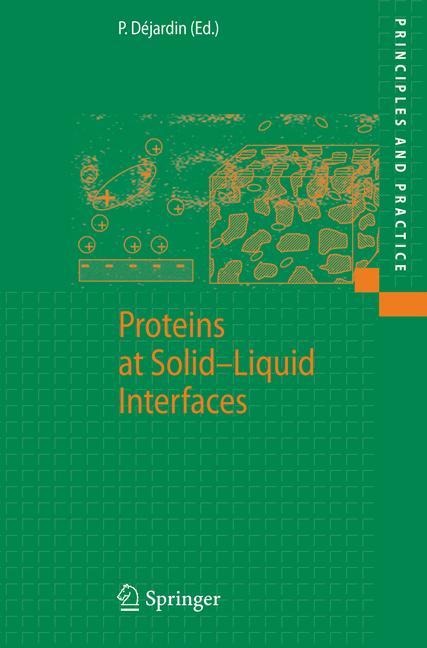
The adsorption of proteins at interfaces plays a role in many ?elds, such as health, food, environment and analysis. Fundamental aspects are useful when considering applications. We focus here especially on solid¿liquid interfaces and present a few fundamental studies regarding adsorption - netics and conformational changes, and examples of applications to sensors and membranes. The ?rst part is dedicated t ... Full description
You May Also Like
 TOP
TOP

Six Not-so-easy Pieces: Einstein's Relativity, Symmetry, and Space-Time
Richard P. Feynman, Robert B. Leighton, Matthew Sands
-20% with code BOOKS
In stock at our supplier
TOP

Six Easy Pieces: Essentials of Physics Explained by Its Most Brilliant Teacher
Richard P. Feynman, Robert B. Leighton, Matthew Sands
-20% with code BOOKS
In stock at our supplier
TOP

Behave: The Biology of Humans at Our Best and Worst
-20% with code BOOKS
In stock at our supplier
TOP

Determined: The Science of Life Without Free Will
-20% with code BOOKS
In stock at our supplier
TOP


The Age of Alchemy: How Early Innovators Shaped Modern Chemistry
-20% with code BOOKS
In stock at our supplier
TOP

The Secrets of our DNA: How Genetics has Changed the World
-20% with code BOOKS
In stock at our supplier
TOP

Why We Sleep: Unlocking the Power of Sleep and Dreams
-20% with code BOOKS
In stock
TOP

Biology: A Global Approach, Global Edition
Neil Campbell, Rebecca Orr, Lisa Urry, Peter Minorsky, Michael Cain, Jane Reece, Steven Wasserman
-20% with code BOOKS
In stock at our supplier
TOP

Why Machines Learn: The Elegant Maths Behind Modern AI
-20% with code BOOKS
In stock at our supplier
TOP

A Short History of Nearly Everything 2.0
-20% with code BOOKS
In stock at our supplier
TOP

Astrophysics for People in a Hurry: Essays on the Universe and Our Place Within It
-20% with code BOOKS
In stock at our supplier
TOP

The Rise and Fall of the Dinosaurs: A New History of a Lost World
-20% with code BOOKS
In stock at our supplier
TOP

The Rise and Reign of the Mammals: A New History, from the Shadow of the Dinosaurs to Us
-20% with code BOOKS
In stock at our supplier
TOP

Learn Faster, Perform Better: A Musician's Guide to the Neuroscience of Practicing
-20% with code BOOKS
In stock at our supplier
TOP

Beyond Inheritance: Our Ever-Mutating Cells and a New Understanding of Health
-20% with code BOOKS
In stock at our supplier
TOP

A Brief History of Time: From the Big Bang to Black Holes
-20% with code BOOKS
In stock at our supplier
 TOP
TOP

Thing Explainer: Complicated Stuff in Simple Words
-20% with code BOOKS
In stock at our supplier
TOP

Introduction to Quantum Mechanics
Darrell F. Schroeter, David J. Griffiths
-20% with code BOOKS
In stock at our supplier
TOP

Universe: The Definitive Visual Guide
-20% with code BOOKS
In stock at our supplier
Description
The adsorption of proteins at interfaces plays a role in many ?elds, such as health, food, environment and analysis. Fundamental aspects are useful when considering applications. We focus here especially on solid¿liquid interfaces and present a few fundamental studies regarding adsorption - netics and conformational changes, and examples of applications to sensors and membranes. The ?rst part is dedicated to fundamental studies performed using - tical waveguide lightmode spectroscopy, as an example of a technique that has the advantage of not requiring labelled proteins, but is limited to s- ci?c supports. Conversely, the radiolabelling of proteins, which has the disadvantage of any labelling process, allows application to any kind of s- faces. As proteins bear both positive and negative charges, we can expect thein?uenceofanelectric?eldnormaltothe interfaceonthe pack- ing order at interfaces. The re?ning of data treatment may also lead to the determination of useful structural parameters. The balance between protein¿surface and protein¿protein interactions is a key point for the - scription of the structure at high coverage of the surface. Electrokinetic methods, like measurement of the streaming potential, may be helpful in the electrical characterisation of the interfacial layer facing the solution. The second part includes different bench techniques that were dev- oped to improve the sensitivity of the characterisation of the orientation and structure of the proteins at interfaces: dual polarisation interferometry and total internal re?ection ellipsometry are such recent examples.
More Information
| Publisher | Springer Berlin Heidelberg |
|---|---|
| Series | Principles and Practice |
| Release year | 2006 |
| Cover type | Hardcover |
| EAN | 9783540326571 |