
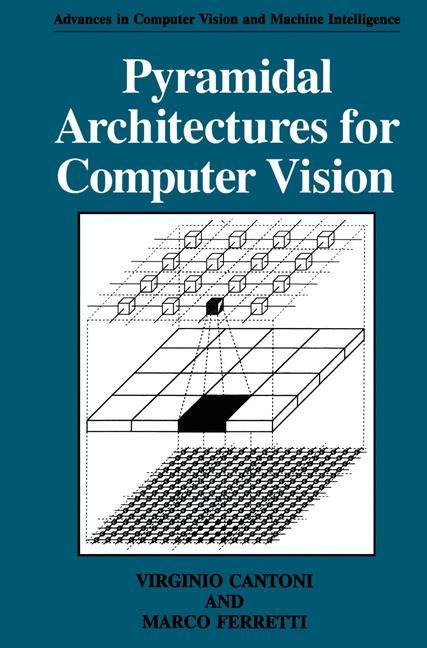
Pyramidal Architectures for Computer Vision - Virginio Cantoni,Marco Ferretti
-30% with code BOOKS
Shipping in 12-18 days
30-day return policy
Computer vision deals with the problem of manipulating information contained in large quantities of sensory data, where raw data emerge from the transducing 6 7 sensors at rates between 10 to 10 pixels per second. Conventional general purpose computers are unable to achieve the computation rates required to op erate in real time or even in near real time, so massively parallel systems have been used since ... Full description
You May Also Like

 TOP
TOP

INCOSE Systems Engineering Handbook
-30% with code BOOKS
In stock at our supplier
TOP

If Anyone Builds It, Everyone Dies: The Case Against Superintelligent AI
Eliezer Yudkowsky, Nate Soares
-30% with code BOOKS
In stock at our supplier
 TOP
TOP
Open Circuits: The Inner Beauty of Electronic Components
Eric Schlaepfer, Windell Oskay
-30% with code BOOKS
In stock at our supplier
TOP
Get started with MicroPython on Raspberry Pi Pico: The Official Raspberry Pi Pico Guide
-30% with code BOOKS
In stock at our supplier
TOP


We Are Not Machines: The Fight for the Future of Work
-30% with code BOOKS
In stock at our supplier
TOP

Foundations of Flavor: The Noma Guide to Fermentation: Including Step-By-Step Information on Making and Cooking with: Koji, Kombuchas, Shoyus, Misos, Vinegars, Garums, Lacto-Ferments and black Fruits Vegetables
-30% with code BOOKS
In stock at our supplier
TOP

Nucleo Boards Programming with the STM32CubeIDE: Hands-on in more than 50 projects
-30% with code BOOKS
In stock at our supplier
TOP
Data-Driven Science and Engineering: Machine Learning, Dynamical Systems, and Control
Steven L. Brunton, J. Nathan Kutz
-30% with code BOOKS
In stock at our supplier
TOP

Fundamentals of Aerodynamics ISE
Christopher Cadou, John D. Anderson
-30% with code BOOKS
In stock at our supplier
TOP

Black Holes: The Key to Understanding the Universe
-30% with code BOOKS
In stock at our supplier
TOP

Practical Electronics for Inventors
-30% with code BOOKS
In stock at our supplier
TOP

Flowers For Algernon: A Modern Literary Classic
-30% with code BOOKS
In stock at our supplier
TOP

Human Compatible: Artificial Intelligence and the Problem of Control
-30% with code BOOKS
In stock at our supplier
TOP

How To Read Water: Clues & Patterns from Puddles to the Sea
-30% with code BOOKS
In stock at our supplier
TOP

Make: Electronics: Learning by Discovery: A hands-on primer for the new electronics enthusiast
-30% with code BOOKS
In stock at our supplier
TOP

Mastering the Arduino Uno R4: Programming and Projects for the Minima and WiFi
-30% with code BOOKS
In stock at our supplier
TOP

The Idea Factory: Bell Labs and the Great Age of American Innovation
-30% with code BOOKS
In stock at our supplier

Description
Computer vision deals with the problem of manipulating information contained in large quantities of sensory data, where raw data emerge from the transducing 6 7 sensors at rates between 10 to 10 pixels per second. Conventional general purpose computers are unable to achieve the computation rates required to op erate in real time or even in near real time, so massively parallel systems have been used since their conception in this important practical application area. The development of massively parallel computers was initially character ized by efforts to reach a speedup factor equal to the number of processing elements (linear scaling assumption). This behavior pattern can nearly be achieved only when there is a perfect match between the computational struc ture or data structure and the system architecture. The theory of hierarchical modular systems (HMSs) has shown that even a small number of hierarchical levels can sizably increase the effectiveness of very large systems. In fact, in the last decade several hierarchical architectures that support capabilities which can overcome performances gained with the assumption of linear scaling have been proposed. Of these architectures, the most commonly considered in com puter vision is the one based on a very large number of processing elements (PEs) embedded in a pyramidal structure. Pyramidal architectures supply the same image at different resolution lev els, thus ensuring the use of the most appropriate resolution for the operation, task, and image at hand.
More Information
| Author | Virginio Cantoni, Marco Ferretti |
|---|---|
| Publisher | Springer New York |
| Series | Advances in Computer Vision and Machine Intelligence |
| Release year | 2012 |
| Cover type | Softcover |
| EAN | 9781461360230 |