
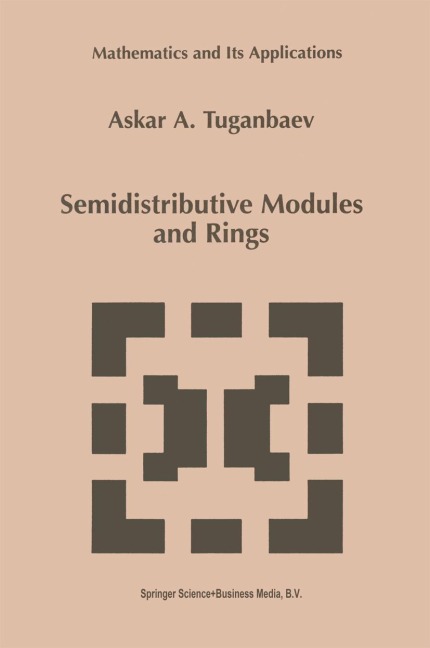
Semidistributive Modules and Rings - A. A. Tuganbaev
-30% with code BOOKS
Shipping in 12-18 days
30-day return policy
A module M is called distributive if the lattice Lat(M) of all its submodules is distributive, i.e., Fn(G + H) = FnG + FnH for all submodules F,G, and H of the module M. A module M is called uniserial if all its submodules are comparable with respect to inclusion, i.e., the lattice Lat(M) is a chain. Any direct sum of distributive (resp. uniserial) modules is called a semidistributive (resp. serial) module. ... Full description
You May Also Like
 TOP
TOP

Determined: The Science of Life Without Free Will
-30% with code BOOKS
In stock at our supplier
TOP

The Light Eaters: How the Unseen World of Plant Intelligence Offers a New Understanding of Life on Earth
-30% with code BOOKS
In stock at our supplier
 TOP
TOP
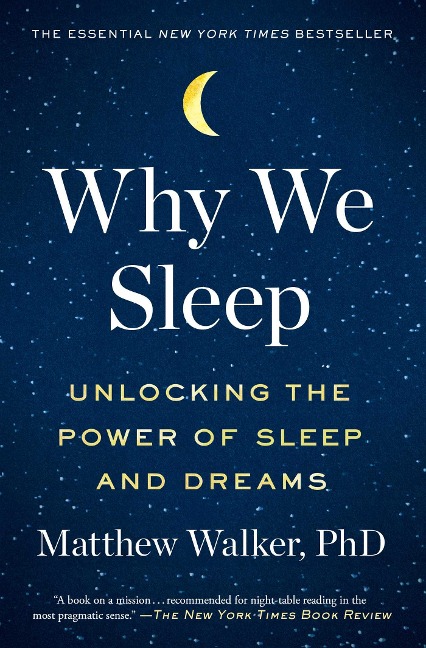
Why We Sleep: Unlocking the Power of Sleep and Dreams
-30% with code BOOKS
In stock
TOP

The Rise and Fall of the Dinosaurs: A New History of a Lost World
-30% with code BOOKS
In stock at our supplier
TOP

Biology: A Global Approach, Global Edition
Neil Campbell, Rebecca Orr, Lisa Urry, Peter Minorsky, Michael Cain, Jane Reece, Steven Wasserman
-30% with code BOOKS
In stock at our supplier
TOP

Six Not-so-easy Pieces: Einstein's Relativity, Symmetry, and Space-Time
Richard P. Feynman, Robert B. Leighton, Matthew Sands
-30% with code BOOKS
In stock at our supplier
TOP

Explaining AuDHD: The expert-led guide to Autism and ADHD Co-concurrence
-30% with code BOOKS
In stock at our supplier
TOP


The Age of Alchemy: How Early Innovators Shaped Modern Chemistry
-30% with code BOOKS
In stock at our supplier
TOP
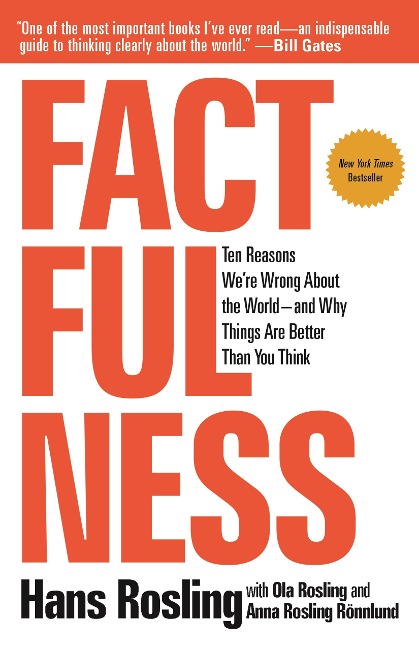
Factfulness: Ten Reasons We're Wrong About the World--and Why Things Are Better Than You Think
Ola Rosling, Anna Rosling Rönnlund, Hans Rosling
-30% with code BOOKS
In stock at our supplier
TOP
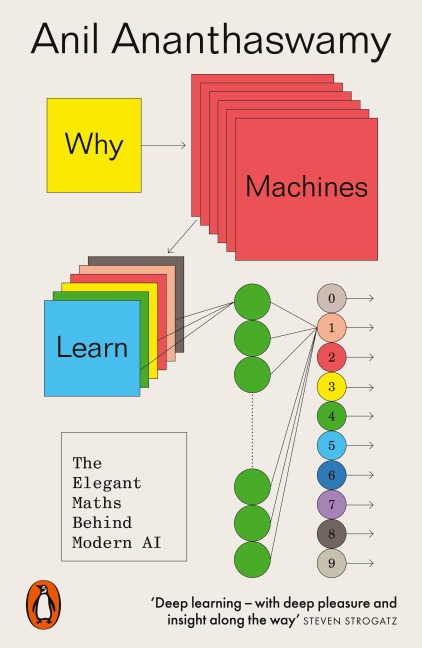
Why Machines Learn: The Elegant Maths Behind Modern AI
-30% with code BOOKS
In stock at our supplier
 TOP
TOP

Entangled Life: How Fungi Make Our Worlds, Change Our Minds and Shape Our Futures
-30% with code BOOKS
In stock at our supplier
TOP

Life As No One Knows It: The Physics of Life's Emergence
-30% with code BOOKS
In stock at our supplier
TOP

The Rise and Reign of the Mammals: A New History, from the Shadow of the Dinosaurs to Us
-30% with code BOOKS
In stock at our supplier
TOP

Molecular Biology of the Cell
David Morgan, Alexander Johnson, Rebecca Heald, Bruce Alberts, Martin Raff
-30% with code BOOKS
In stock at our supplier
TOP

Learn Faster, Perform Better: A Musician's Guide to the Neuroscience of Practicing
-30% with code BOOKS
In stock at our supplier
TOP

Janeway's Immunobiology
Leslie J. Berg, Kenneth Murphy, Casey Weaver
-30% with code BOOKS
In stock at our supplier
TOP

The Road to Reality: A Complete Guide to the Laws of the Universe
-30% with code BOOKS
In stock at our supplier
TOP
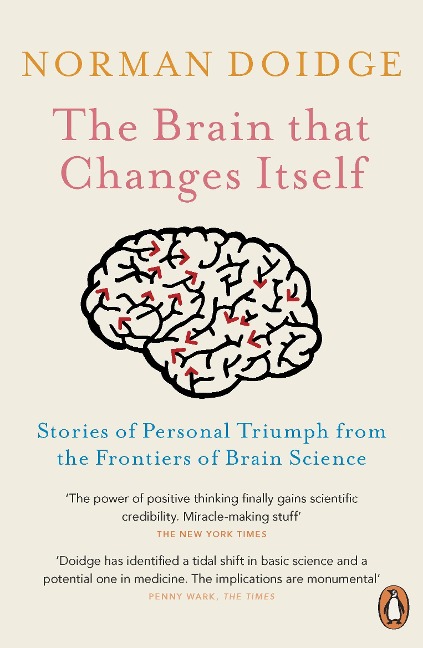
The Brain That Changes Itself: Stories of Personal Triumph from the Frontiers of Brain Science
-30% with code BOOKS
In stock at our supplier
Description
A module M is called distributive if the lattice Lat(M) of all its submodules is distributive, i.e., Fn(G + H) = FnG + FnH for all submodules F,G, and H of the module M. A module M is called uniserial if all its submodules are comparable with respect to inclusion, i.e., the lattice Lat(M) is a chain. Any direct sum of distributive (resp. uniserial) modules is called a semidistributive (resp. serial) module. The class of distributive (resp. semidistributive) modules properly cont.ains the class ofall uniserial (resp. serial) modules. In particular, all simple (resp. semisimple) modules are distributive (resp. semidistributive). All strongly regular rings (for example, all factor rings of direct products of division rings and all commutative regular rings) are distributive; all valuation rings in division rings and all commutative Dedekind rings (e.g., rings of integral algebraic numbers or commutative principal ideal rings) are distributive. A module is called a Bezout module or a locally cyclic module ifevery finitely generated submodule is cyclic. If all maximal right ideals of a ring A are ideals (e.g., if A is commutative), then all Bezout A-modules are distributive.
More Information
| Author | A. A. Tuganbaev |
|---|---|
| Publisher | Springer Netherlands |
| Series | Mathematics and Its Applications |
| Release year | 2012 |
| Cover type | Softcover |
| EAN | 9789401061360 |