
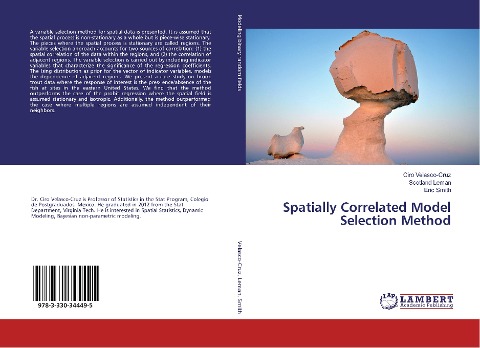
Spatially Correlated Model Selection Method - Ciro Velasco-Cruz,Scotland Leman,Eric Smith
-20% with code BOOKS
Shipping in 12-18 days
30-day return policy
A variable selection method for spatial data is presented. It is assumed that the spatial process is non-stationary as a whole but is piece-wise stationary. The pieces where the spatial process is stationary are called regions. The variable selection approach accounts for two sources of correlation: (1) the spatial correlation of the data within the regions, and (2) the correlation of adjacent regions. The ... Full description
You May Also Like
 TOP
TOP

Factfulness: Ten Reasons We're Wrong About the World--and Why Things Are Better Than You Think
Ola Rosling, Anna Rosling Rönnlund, Hans Rosling
-20% with code BOOKS
In stock at our supplier
TOP

Biology: A Global Approach, Global Edition
Neil Campbell, Rebecca Orr, Lisa Urry, Peter Minorsky, Michael Cain, Jane Reece, Steven Wasserman
-20% with code BOOKS
In stock at our supplier
TOP

Six Not-so-easy Pieces: Einstein's Relativity, Symmetry, and Space-Time
Richard P. Feynman, Robert B. Leighton, Matthew Sands
-20% with code BOOKS
In stock at our supplier
TOP

Determined: The Science of Life Without Free Will
-20% with code BOOKS
In stock at our supplier
 TOP
TOP


The Age of Alchemy: How Early Innovators Shaped Modern Chemistry
-20% with code BOOKS
In stock at our supplier
TOP

The Secrets of our DNA: How Genetics has Changed the World
-20% with code BOOKS
In stock at our supplier
TOP

Janeway's Immunobiology
Leslie J. Berg, Kenneth Murphy, Casey Weaver
-20% with code BOOKS
In stock at our supplier
TOP

How to Solve it: A New Aspect of Mathematical Method
-20% with code BOOKS
In stock at our supplier
TOP
Why We Sleep: Unlocking the Power of Sleep and Dreams
-20% with code BOOKS
In stock
TOP

The Light Eaters: How the Unseen World of Plant Intelligence Offers a New Understanding of Life on Earth
-20% with code BOOKS
In stock at our supplier
TOP

Six Easy Pieces: Essentials of Physics Explained by Its Most Brilliant Teacher
Richard P. Feynman, Robert B. Leighton, Matthew Sands
-20% with code BOOKS
In stock at our supplier
TOP
The Rise and Fall of the Dinosaurs: A New History of a Lost World
-20% with code BOOKS
In stock at our supplier
TOP
The Rise and Reign of the Mammals: A New History, from the Shadow of the Dinosaurs to Us
-20% with code BOOKS
In stock at our supplier
TOP
Learn Faster, Perform Better: A Musician's Guide to the Neuroscience of Practicing
-20% with code BOOKS
In stock at our supplier
 TOP
TOP

The Feynman Lectures on Physics. The New Millennium Edition
Matthew Sands, Robert Leighton, Richard Feynman
-20% with code BOOKS
In stock at our supplier
TOP

Thing Explainer: Complicated Stuff in Simple Words
-20% with code BOOKS
In stock at our supplier
TOP
Behave: The Biology of Humans at Our Best and Worst
-20% with code BOOKS
In stock at our supplier
TOP

Introduction to Quantum Mechanics
Darrell F. Schroeter, David J. Griffiths
-20% with code BOOKS
In stock at our supplier
Description
A variable selection method for spatial data is presented. It is assumed that the spatial process is non-stationary as a whole but is piece-wise stationary. The pieces where the spatial process is stationary are called regions. The variable selection approach accounts for two sources of correlation: (1) the spatial correlation of the data within the regions, and (2) the correlation of adjacent regions. The variable selection is carried out by including indicator variables that characterize the significance of the regression coefficients. The Ising distribution as prior for the vector of indicator variables, models the dependence of adjacent regions. We present a case study on brook trout data where the response of interest is the pres- ence/absence of the fish at sites in the eastern United States. We find that the method outperforms the case of the probit regression where the spatial field is assumed stationary and isotropic. Additionally, the method outperformed the case where multiple regions are assumed independent of their neighbors.
More Information
| Author | Ciro Velasco-Cruz, Scotland Leman, Eric Smith |
|---|---|
| Publisher | LAP LAMBERT Academic Publishing |
| Release year | 2017 |
| Cover type | Softcover |
| EAN | 9783330344495 |