
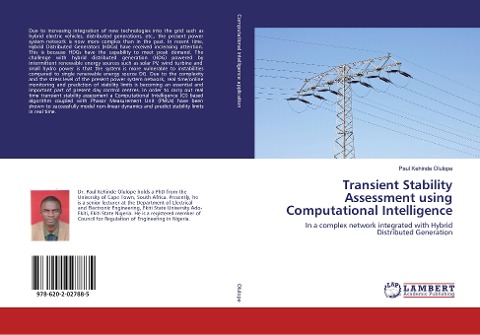
Transient Stability Assessment using Computational Intelligence: In a complex network integrated with Hybrid Distributed Generation - Paul Kehinde Olulope
-20% with code BOOKS
Shipping in 12-18 days
30-day return policy
Due to increasing integration of new technologies into the grid such as hybrid electric vehicles, distributed generations, etc., the present power system network is now more complex than in the past. In recent time, Hybrid Distributed Generators (HDGs) have received increasing attention. This is because HDGs have the capability to meet peak demand. The challenge with hybrid distributed generation (HDG) powe ... Full description
You May Also Like

 TOP
TOP

INCOSE Systems Engineering Handbook
-20% with code BOOKS
In stock at our supplier
TOP

If Anyone Builds It, Everyone Dies: The Case Against Superintelligent AI
Eliezer Yudkowsky, Nate Soares
-20% with code BOOKS
In stock at our supplier
 TOP
TOP

Open Circuits: The Inner Beauty of Electronic Components
Eric Schlaepfer, Windell Oskay
-20% with code BOOKS
In stock at our supplier
TOP

Get started with MicroPython on Raspberry Pi Pico: The Official Raspberry Pi Pico Guide
-20% with code BOOKS
In stock at our supplier
TOP

Practical Electronics for Inventors
-20% with code BOOKS
In stock at our supplier
TOP

Nucleo Boards Programming with the STM32CubeIDE: Hands-on in more than 50 projects
-20% with code BOOKS
In stock at our supplier
TOP

Data-Driven Science and Engineering: Machine Learning, Dynamical Systems, and Control
Steven L. Brunton, J. Nathan Kutz
-20% with code BOOKS
In stock at our supplier
TOP

Fundamentals of Aerodynamics ISE
Christopher Cadou, John D. Anderson
-20% with code BOOKS
In stock at our supplier
TOP

Black Holes: The Key to Understanding the Universe
-20% with code BOOKS
In stock at our supplier
TOP

KiCad Like A Pro - Fundamentals and Projects: Getting started with the world's best open-source PCB tool
-20% with code BOOKS
In stock at our supplier
TOP

How To Read Water: Clues & Patterns from Puddles to the Sea
-20% with code BOOKS
In stock at our supplier
TOP

Foundations of Flavor: The Noma Guide to Fermentation: Including Step-By-Step Information on Making and Cooking with: Koji, Kombuchas, Shoyus, Misos, Vinegars, Garums, Lacto-Ferments and black Fruits Vegetables
-20% with code BOOKS
In stock at our supplier
TOP

Make: Electronics: Learning by Discovery: A hands-on primer for the new electronics enthusiast
-20% with code BOOKS
In stock at our supplier
TOP

The Idea Factory: Bell Labs and the Great Age of American Innovation
-20% with code BOOKS
In stock at our supplier
TOP

Flowers For Algernon: A Modern Literary Classic
-20% with code BOOKS
In stock at our supplier
 TOP
TOP


Professional SMD Assembly: Practical Low-Cost Methods for Reliable PCB Production
-20% with code BOOKS
In stock at our supplier
TOP

Blood in the Machine: The Origins of the Rebellion Against Big Tech
-20% with code BOOKS
In stock at our supplier
Description
Due to increasing integration of new technologies into the grid such as hybrid electric vehicles, distributed generations, etc., the present power system network is now more complex than in the past. In recent time, Hybrid Distributed Generators (HDGs) have received increasing attention. This is because HDGs have the capability to meet peak demand. The challenge with hybrid distributed generation (HDG) powered by intermittent renewable energy sources such as solar PV, wind turbine and small hydro power is that the system is more vulnerable to instabilities compared to single renewable energy source DG. Due to the complexity and the stress level of the present power system network, real time/online monitoring and prediction of stability limits is becoming an essential and important part of present day control centres. In order to carry out real time transient stability assessment a Computational Intelligence (CI) based algorithm coupled with Phasor Measurement Unit (PMUs) have been shown to successfully model non-linear dynamics and predict stability limits in real time.
More Information
| Author | Paul Kehinde Olulope |
|---|---|
| Publisher | LAP LAMBERT Academic Publishing |
| Release year | 2017 |
| Cover type | Softcover |
| EAN | 9786202027885 |