
Trigamma Function: Polygamma Function, Digamma Function, Hurwitz Zeta Function -


-20% with code BOOKS
Shipping in 15-21 days
30-day return policy
Please note that the content of this book primarily consists of articles available from Wikipedia or other free sources online. In mathematics, the trigamma function, denoted ¿1(z), is the second of the polygamma functions, and is defined by psi_1(z) = frac{d^2}{dz^2} lnGamma(z). It follows from this definition that psi_1(z) = frac{d}{dz} psi(z) where ¿(z) is the digamma function. It may also be defined as ... Full description
You May Also Like
 TOP
TOP

Six Not-so-easy Pieces: Einstein's Relativity, Symmetry, and Space-Time
Richard P. Feynman, Robert B. Leighton, Matthew Sands
-20% with code BOOKS
In stock at our supplier
TOP

Six Easy Pieces: Essentials of Physics Explained by Its Most Brilliant Teacher
Richard P. Feynman, Robert B. Leighton, Matthew Sands
-20% with code BOOKS
In stock at our supplier
TOP

Behave: The Biology of Humans at Our Best and Worst
-20% with code BOOKS
In stock at our supplier
TOP

Determined: The Science of Life Without Free Will
-20% with code BOOKS
In stock at our supplier
 TOP
TOP

The Age of Alchemy: How Early Innovators Shaped Modern Chemistry
-20% with code BOOKS
In stock at our supplier
TOP

The Secrets of our DNA: How Genetics has Changed the World
-20% with code BOOKS
In stock at our supplier
TOP

Why We Sleep: Unlocking the Power of Sleep and Dreams
-20% with code BOOKS
In stock
TOP

Biology: A Global Approach, Global Edition
Neil Campbell, Rebecca Orr, Lisa Urry, Peter Minorsky, Michael Cain, Jane Reece, Steven Wasserman
-20% with code BOOKS
In stock at our supplier
TOP
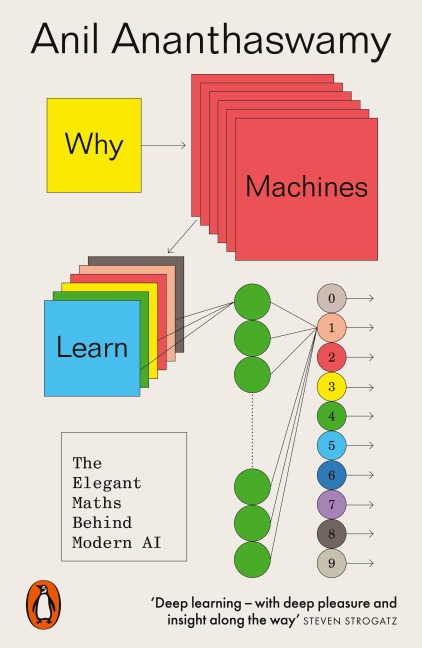
Why Machines Learn: The Elegant Maths Behind Modern AI
-20% with code BOOKS
In stock at our supplier
TOP

A Short History of Nearly Everything 2.0
-20% with code BOOKS
In stock at our supplier
TOP

Astrophysics for People in a Hurry: Essays on the Universe and Our Place Within It
-20% with code BOOKS
In stock at our supplier
TOP

The Rise and Fall of the Dinosaurs: A New History of a Lost World
-20% with code BOOKS
In stock at our supplier
TOP

The Rise and Reign of the Mammals: A New History, from the Shadow of the Dinosaurs to Us
-20% with code BOOKS
In stock at our supplier
TOP

Learn Faster, Perform Better: A Musician's Guide to the Neuroscience of Practicing
-20% with code BOOKS
In stock at our supplier
TOP

Beyond Inheritance: Our Ever-Mutating Cells and a New Understanding of Health
-20% with code BOOKS
In stock at our supplier
TOP

A Brief History of Time: From the Big Bang to Black Holes
-20% with code BOOKS
In stock at our supplier
 TOP
TOP

Thing Explainer: Complicated Stuff in Simple Words
-20% with code BOOKS
In stock at our supplier
TOP

Introduction to Quantum Mechanics
Darrell F. Schroeter, David J. Griffiths
-20% with code BOOKS
In stock at our supplier
Description
More Information
| Publisher | OmniScriptum |
|---|---|
| Release year | 2026 |
| Cover type | Softcover |
| EAN | 9786131141614 |